Table of Contents
Introduction
pH measurement serves as one of the most fundamental and frequently monitored parameters in both desalination and water reuse applications. From controlling antiscalant dosing in reverse osmosis systems to optimizing biological treatment in wastewater reuse, pH directly influences chemical reactions, membrane performance, and biological activity.
Despite its apparent simplicity, pH measurement presents significant challenges in industrial applications. Sensor drift, reference contamination, and temperature effects can introduce substantial measurement errors that compromise process control. Shanghai ChiMay inline pH electrodes address these challenges through advanced electrode technology designed specifically for demanding water treatment environments.
The Critical Role of pH in Desalination
In reverse osmosis desalination, pH affects multiple process parameters that determine system performance and longevity:
Scaling Control
Calcium carbonate scaling represents the most common fouling mechanism in RO systems. The solubility of calcium carbonate, and thus the scaling potential, depends directly on pH:
- At pH < 7.0: Calcium carbonate remains soluble, minimal scaling risk
- At pH 7.0-7.8: Moderate scaling potential, requiring antiscalant dosing
- At pH > 7.8: High scaling potential, requiring aggressive antiscalant treatment or acid dosing
Continuous pH monitoring keeps antiscalant dosing matched to the actual scaling potential instead of a worst-case feed assumption. Plants that move from periodic grab sampling to continuous pH-based control report markedly fewer membrane cleanings and more consistent chemical consumption.
Membrane Compatibility
The polyamide membranes used in most commercial RO systems exhibit pH stability limitations:
- Lower pH limit: roughly pH 2.0-4.0 depending on membrane type
- Upper pH limit: roughly pH 10.0-11.5 depending on membrane chemistry
- Preferred operation: most manufacturers specify a continuous operating band near neutral pH for maximum membrane life, with the full chemical-tolerance range reserved for short cleaning cycles
Exceeding pH limits accelerates membrane hydrolysis, reducing salt rejection efficiency and membrane lifespan. Continuous monitoring prevents accidental pH excursions that cause irreversible membrane damage.
Boron Rejection
In seawater desalination, pH strongly affects boron rejection, which matters for irrigation reuse. Boric acid has a pKa of about 9.2: below that pH, boron is present mainly as uncharged boric acid B(OH)₃, which permeates polyamide membranes relatively easily, so single-pass rejection is only moderate. Raising the pH converts boron to the charged borate ion B(OH)₄⁻, which polyamide membranes reject far more effectively. That is why seawater plants that must meet tight boron limits for agriculture dose caustic soda between RO passes—precise pH control, not membrane selection alone, is the main lever for boron compliance.
pH Control in Water Reuse Biological Treatment
Biological wastewater treatment processes exhibit strong pH sensitivity, making continuous monitoring essential for process optimization:
Nitrification Optimization
Nitrifying bacteria (Nitrosomonas and Nitrobacter) demonstrate optimal activity in the 7.5-8.5 pH range. As pH falls toward 6.5, ammonia oxidation slows markedly, and below about pH 6.0 nitrification effectively stops. Recovery after a severe low-pH event can take weeks, because nitrifiers grow slowly. Continuous pH monitoring enables rapid detection of pH depression and immediate corrective action through alkalinity addition, preventing nitrification failure.
Biological Phosphorus Removal
Enhanced biological phosphorus removal (EBPR) performs best at near-neutral to slightly alkaline pH. Under acidic conditions, glycogen accumulating organisms (GAOs) tend to outcompete polyphosphate accumulating organisms (PAOs) for the volatile fatty acids that drive the process, and phosphorus removal deteriorates accordingly. Maintaining pH in the PAO-favorable band is one of the few reliable process-side controls over the PAO/GAO competition.
Methane Production
Anaerobic digesters treating water reuse sludges operate optimally in the 6.8-7.2 pH range. pH below 6.5 inhibits methanogenic archaea, causing volatile fatty acid accumulation and digester failure; full recovery after a souring event can take weeks to months. Continuous monitoring prevents these process upsets before they compound.
Shanghai ChiMay pH Electrode Technology
Shanghai ChiMay inline pH electrodes utilize advanced electrode designs optimized for water treatment applications:
Glass Membrane Technology
The measurement electrode employs low-impedance glass membranes that provide:
- Fast response: <10 seconds to 95% of final value
- Stable readings: Drift <0.002 pH units per day under standard conditions
- Wide temperature range: 0-100°C continuous operation
- Long life: Typical service life of 18-24 months
Double Junction Reference
The reference electrode utilizes a double junction design with polymer electrolyte that:
- Prevents reference contamination from process water
- Maintains stable reference potential in high-suspended-solids applications
- Provides extended service life in aggressive chemical environments
- Allows measurement in difficult samples containing sulfides and proteins
Automatic Temperature Compensation
Integrated PT1000 temperature elements enable automatic compensation across the measurement range:
- Compensation algorithm: Nernst equation with configurable parameters
- Temperature range: 0-100°C operating range
- Accuracy: ±0.3°C temperature measurement accuracy
- Response: <30 seconds to temperature changes
Integration and Control Implementation
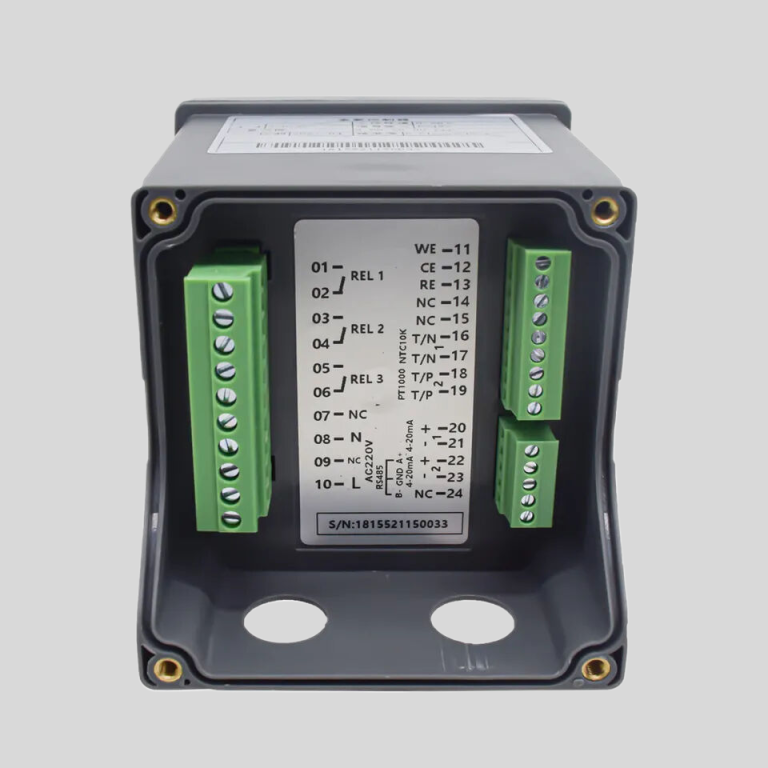
Shanghai ChiMay pH transmitters provide multiple output options for process control integration:
- Analog output: 4-20 mA current loop for DCS integration
- Digital communication: Modbus RTU/TCP for modern control systems
- HART protocol: Asset management system compatibility
- Relay outputs: High/low alarm and dosing control capability
Process control applications include:
- Acid/base dosing control for RO antiscalant pH optimization
- Alkalinity addition control for nitrification protection
- Chemical precipitation control for phosphorus removal
- Disinfection control where chlorine efficacy depends on pH
Maintenance Best Practices
Proper maintenance ensures measurement accuracy and extends sensor life:
Calibration Protocol
Two-point calibration using NIST-traceable buffer solutions:
- Buffer selection: pH 4.0 (or 7.0) and pH 10.0 buffers
- Calibration frequency: Monthly under stable conditions, weekly in harsh applications
- Documentation: Record calibration slope and offset for trend analysis
- Verification: Daily buffer check between formal calibrations
Cleaning Procedures
Regular cleaning prevents sensor fouling:
- Physical cleaning: Gentle brushing removes biofilm accumulation
- Chemical cleaning: Acid or base cleaning removes scale or organic deposits
- Storage: Electrode storage in 3M KCl solution when not in service
- Replacement: Replace electrode when slope falls below 85% of theoretical value
Installation Considerations
Proper installation prevents common measurement problems:
- Flow velocity: Maintain 0.3-2.0 m/s flow past electrode surface
- Orientation: Position electrode with membrane downward in vertical installations
- Air exclusion: Prevent air bubbles adhering to membrane surface
- Temperature gradients: Avoid installation near heating/cooling elements
Economic Impact Analysis
Investment in continuous pH monitoring is typically one to a few thousand dollars per measurement point. Economic benefits include:
Chemical Optimization: Precise pH control matches acid/base consumption to actual demand instead of manual over-dosing, cutting chemical spend in direct proportion to how manual the previous control was.
Membrane Protection: Preventing pH excursions extends membrane life and reduces replacement frequency; membrane replacement is among the largest recurring costs in an RO plant, so even a modest extension is worth real money.
Process Stability: Avoided biological upsets and permit excursions prevent remediation costs and the enforcement exposure that follows violations—in the United States, Clean Water Act penalties can reach $68,445 per violation per day (2025 adjustment, 40 CFR 19.4).
Conclusion
pH measurement provides essential process control information for both desalination and water reuse applications. Shanghai ChiMay inline pH electrodes deliver the accuracy, reliability, and integration capability required for critical process control. Facilities implementing continuous pH monitoring achieve improved chemical efficiency, extended equipment life, and enhanced process stability.
The combination of advanced electrode technology, flexible integration options, and established field performance makes these sensors a practical foundation for desalination and water reuse facility instrumentation.