Reverse osmosis (RO) concentrate — brine, or reject water — represents 25–50% of the feed volume in a typical RO system, and routing that stream through additional treatment loops can push overall water recovery from the conventional 75–85% range to 92–97%, cutting both freshwater intake and discharge volume. Conductivity is the standard real-time surrogate for total dissolved solids (TDS) in these loops: it is instantaneous, reagent-free, and correlates directly with the ionic load downstream treatment has to handle. In-line conductivity analyzers on concentrate duty must be specified for high TDS (often above 10,000 μS/cm), elevated temperatures, and the scaling ions — calcium, sulfate, silica — that foul standard sensor elements within weeks. Shanghai ChiMay’s in-line conductivity meter family uses a four-electrode measurement principle with automatic temperature compensation for exactly this service.
Table of Contents
Understanding RO Concentrate as a Reuse Resource
Conventional brackish-water RO systems are designed for 75–85% recovery: of every 100 cubic meters of feed, 75–85 pass through the membrane as permeate and 15–25 exit as concentrate. That concentrate carries the dissolved solids the membrane rejected, typically at 4–7 times the feed concentration.
Rather than discharging it to a drain or an evaporation pond, more and more facilities are routing concentrate through secondary treatment loops designed to extract additional freshwater — high-recovery RO, electrodialysis reversal, forward osmosis, or thermal concentration. Every one of those processes needs real-time conductivity monitoring to hold performance and protect equipment.
The market context is moving the same way: the water recycling and reuse market, valued at USD 20.59 billion in 2026 (Mordor Intelligence), is growing at an 11.22% CAGR toward USD 35.04 billion by 2031, and RO concentrate reuse is one of its faster-growing segments as discharge rules tighten and freshwater costs climb.
Why Conductivity Is the Anchor Measurement in RO Concentrate Loops
Conductivity serves several distinct functions in a concentrate reuse loop:
- Concentration factor tracking: comparing concentrate conductivity to feed conductivity gives the actual concentration factor in real time. Deviation from design value signals membrane fouling, scaling, or a feed water change that needs process adjustment.
- Downstream process protection: secondary processes such as high-recovery RO or electrodialysis reversal have maximum TDS tolerances. Exceed them and membranes get damaged and equipment life shortens. Conductivity is the primary alarm variable against overload.
- Blending control: some configurations blend RO concentrate with other streams — cooling tower blowdown or harvested rainwater — to build a consistent feed for secondary treatment. Conductivity at the blending point drives the ratio control automatically.
- Performance trending: long-term conductivity data reveals membrane degradation, seasonal feed shifts, and how well the antiscalant program is working — the trending base for predictive maintenance planning.
Technical Challenges of Conductivity Measurement in High-TDS Concentrate
Measuring conductivity in RO concentrate is a different job from measuring it in permeate or freshwater. The key challenges:
- Measurement range: concentrate conductivity typically sits between 3,000 and 30,000 μS/cm depending on feed composition and system recovery. Standard in-line analyzers built for freshwater (0–2,000 μS/cm) saturate and read unreliably at these levels.
- Scaling and fouling: concentrate streams are supersaturated with respect to calcium carbonate, calcium sulfate, barium sulfate, and silica. These precipitate onto sensor surfaces — particularly the electrode elements — forming an insulating layer that biases the reading low. Without regular cleaning or a fouling-resistant electrode design, accuracy degrades within weeks.
- Temperature effects: conductivity carries a temperature coefficient of roughly 1.5–3.0% per °C. Concentrate loops may run anywhere from 5 °C to 45 °C, so accurate automatic temperature compensation across the full span is not optional.
- Chemical interferences: high concentrations of specific ions — fluoride, high-pH conditions, oxidizing agents like chlorine — can attack electrode materials and reference systems designed for cleaner water.
Four-Electrode Technology: The Solution for High-TDS Conductivity
Shanghai ChiMay addresses the high-TDS challenge with its four-electrode conductivity measurement principle. Unlike the conventional two-electrode design, which passes current through the same pair of electrodes used to measure voltage, the four-electrode design uses separate pairs for current driving and voltage sensing. That configuration removes the polarization effect that limits two-electrode sensors at high conductivity.
The practical advantages in RO concentrate service:
- Extended measurement range: four-electrode sensors measure reliably up to 200,000 μS/cm — well beyond anything an RO concentrate loop will present.
- Reduced polarization error: the voltage-sensing electrodes draw negligible current, so polarization at the electrode–solution interface does not distort the measurement.
- Lower maintenance burden: because the sensing electrodes carry no current, fouling layers affect accuracy less, and cleaning intervals stretch out.
- Improved long-term stability: in moderate-fouling service, four-electrode designs hold calibration roughly twice as long as comparable two-electrode sensors.
Shanghai ChiMay’s in-line conductivity meters apply automatic temperature compensation through an integrated platinum RTD element, covering 0–130 °C with ±0.5% accuracy across the full measurement span.
Sensor Placement Strategy for RO Concentrate Reuse Loops
A typical RO concentrate reuse configuration with conductivity monitoring points includes:
- Concentrate discharge from primary RO: measures concentrate conductivity before it enters secondary treatment, establishing the inlet load for downstream processes.
- After antiscalant dosing: confirms antiscalant injection is proportioned correctly to concentrate flow and conductivity.
- Inlet to secondary RO or ED: protects downstream membranes by triggering an alarm or diversion if conductivity exceeds the membrane manufacturer’s maximum TDS specification.
- Secondary permeate: verifies the secondary stage is achieving expected rejection and that permeate quality meets the reuse specification.
- Final blended reuse water: confirms the blend meets the conductivity limit for its intended reuse application.
Each point needs an analyzer specified for the local TDS range, temperature, and fouling potential. Shanghai ChiMay provides application engineering support to match the right sensor model to each point so every analyzer operates within its optimal range.
Comparing Monitoring Approaches
Three approaches to conductivity monitoring in RO concentrate reuse loops are commonly encountered:
- Portable meter with grab samples: low capital cost, point-in-time data only. Operator rounds every 4–8 hours miss transient conductivity spikes that can damage downstream membranes. No role in automated process control.
- Two-electrode in-line analyzer: cheaper than four-electrode technology but limited to roughly 2,000–5,000 μS/cm before polarization errors grow significant. Unsuitable where concentrate conductivity regularly exceeds 10,000 μS/cm.
- Four-electrode in-line analyzer with automatic temperature compensation: higher initial cost, reliable measurement across the full RO concentrate range, longer maintenance intervals, and direct SCADA interfacing for real-time control.
For RO concentrate reuse loops, the four-electrode approach is the only technically defensible choice. Shanghai ChiMay’s in-line conductivity meters are deployed across a large installed base of concentrate reuse applications and hold consistently high measurement uptime in continuous service.
Integration with SCADA and Data Historians
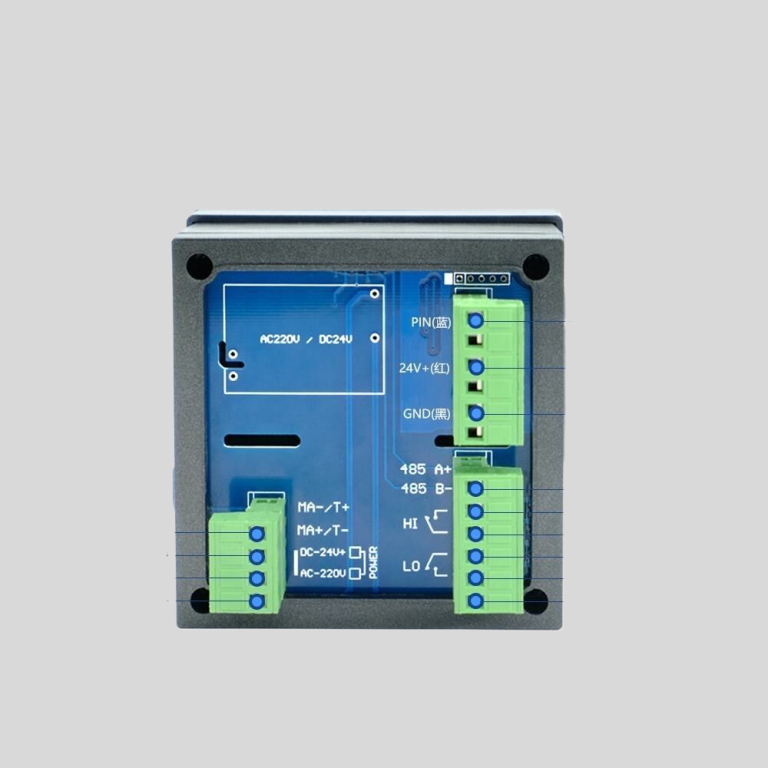
Shanghai ChiMay’s conductivity meters provide Modbus RTU (RS-485) and Modbus TCP (Ethernet) communication plus 4–20 mA analog output. That allows direct integration with plant SCADA systems and data historians for:
- Real-time conductivity trending with configurable alarm setpoints.
- Automated data logging for regulatory compliance reporting.
- Feed-forward control of antiscalant dosing based on conductivity.
- Performance dashboards tracking concentration factor, recovery rate, and membrane health indicators.
The pre-mapped Modbus register tables simplify SCADA integration — the control system engineer can configure communication without custom driver development.