Short answer:
- Drainage systems are usually managed reactively: crews respond after a blockage, an overflow, or a complaint. Continuous monitoring turns the same network into something you can watch.
- Conductivity and turbidity are the most useful pair for drainage duty. They separate storm flow from sewage, and they detect sediment build-up before it becomes a blockage.
- pH and dissolved oxygen matter at the discharge end, where the drainage system meets a receiving water body.
- Alarms only help if they are tied to site-specific baselines and someone owns the response.
Urban drainage systems face growing pressure as precipitation extremes intensify. Reactive maintenance, which waits for a blockage or a complaint, does not scale to that kind of variability. Leading municipalities are installing continuous monitoring that turns drainage infrastructure from passive conduit into something operators can see and act on.
Table of Contents
The Data Revolution in Municipal Drainage
Modern drainage monitoring goes well beyond periodic inspection. Water quality instruments and level sensors in the network produce a continuous record, and that record changes three things: how fast problems are identified, how well maintenance effort is targeted, and how much of the network’s behaviour is documented for regulators.
The American Society of Civil Engineers and other municipal engineering bodies have promoted condition assessment and asset management for drainage networks for years, and continuous monitoring is the measurement layer that makes those programmes work on a system that is mostly underground and rarely inspected.
Turbidity sensors at critical junctions detect accumulating debris and sediment before a blockage develops. During dry weather, a sustained turbidity rise normally means something is entering the system that should not be: construction runoff, a misconnected sewer, or illegal dumping. During wet weather, the same sensor shows how the first flush moves through the network, which is what determines how much contaminated water reaches the receiving stream.
Where the local authority has a baseline and a response plan, studies of drainage monitoring programmes report that early turbidity and level data prevents a substantial share of severe blockage events, mainly because the crew is dispatched to clean a reach before it plugs rather than after it floods.
Conductivity Sensors: The Foundation of Intelligent Drainage
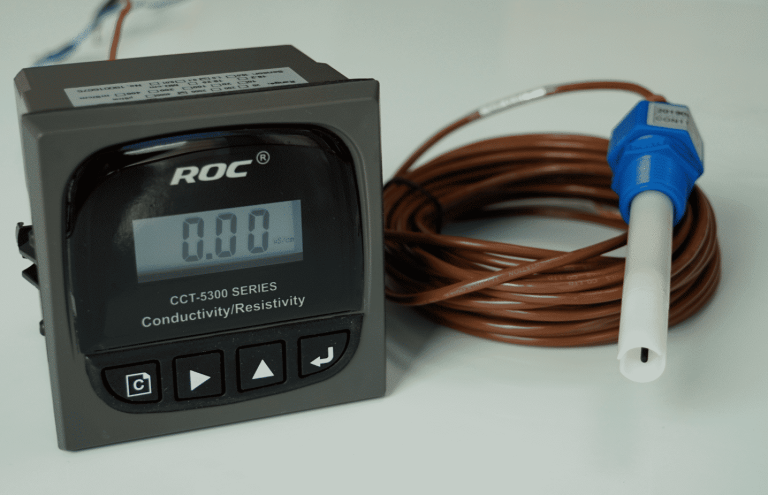
Conductivity measurement reveals what the water in a drainage system actually is. Inline sensors detect changes in dissolved solid concentrations that point to different operational problems: a sudden spike usually means an industrial discharge that deserves regulatory attention, while a slow upward drift over weeks suggests accumulating scale or sediment, or a change in the mix of flow sources.
The most useful application is flow source discrimination. Sanitary sewage and stormwater have different ionic fingerprints, and conductivity separates them in real time, which matters at combined sewer overflow points. When conductivity indicates that a dry-weather flow is largely sanitary rather than stormwater, operators can retain and route that flow to treatment instead of discharging it. Automated valve control responding to that signal reduces untreated discharge volumes at overflow points, and because the decision is based on measurement rather than on a level trigger alone, the retained volume is genuinely the fraction that needed treatment.
That logic only works with local calibration. Conductivity ranges differ between catchments with different geology, road salt practice, and industrial mix, so the alarm values should be derived from site data.
pH Monitoring for Infrastructure Protection
Drainage structures are expensive and they corrode. Concrete and metal components degrade faster under prolonged acidic exposure, and in sewers the classic mechanism is microbiological: sulfide generated in stagnant, septic conditions converts to sulfuric acid at the crown of the pipe, which attacks concrete directly.
Inline pH sensors support protection in two ways:
- Early detection: a pH excursion flags an unauthorized discharge or a septic condition developing in a reach. Preventive neutralization or flushing can be triggered from continuous data rather than from an inspection.
- Targeted maintenance: pH and sulfide history shows which reaches are degrading, so rehabilitation budget goes to the structures that need it instead of being spread evenly.
Municipalities running comprehensive pH monitoring networks report lower maintenance costs over multi-year periods and the strongest returns in industrial areas, where accidental discharges create corrosive conditions that a visual inspection would not catch until damage was visible.
Dissolved Oxygen: Protecting Receiving Waters
Drainage management has to account for the water body at the outfall. Dissolved oxygen transmitters at discharge points show whether outflows will support aquatic life. When oxygen saturation drops toward a site-specific threshold, operators can reduce discharge rates or bring supplemental aeration online, which is often the difference between a localized oxygen sag and a fish kill.
Dutch research institutions working on urban drainage and receiving water quality have shown the general pattern that measurement-based control outperforms time-based discharge rules: systems that discharge according to measured water quality meet receiving water standards more consistently than those that discharge on a fixed schedule, because a schedule cannot know when a storm carries a high pollutant load.
Economic Analysis of Continuous Monitoring Investment
Deployment costs for a comprehensive sensor network depend on how much civil work is needed to install instruments in chambers, and on communications. In practice the instrumentation is a modest share of the total; the access, power, and telemetry are what drive cost.
Against that, the savings fall into categories that are easier to quantify than flood damage:
- Maintenance efficiency: cleaning and inspection crews dispatched to the reaches that actually need attention
- Reduced emergency response: blockages caught before they flood streets or properties
- Avoided penalties: evidence that overflows and discharges are being managed, and faster notification when they occur
- Longer asset life: corrosion and sediment problems found early
Utilities that only count avoided flood damage will find the payback difficult to prove, because the avoided events are hypothetical. Utilities that count maintenance productivity, overflow documentation, and asset life generally find the business case straightforward, with payback typically inside a few years on large trunk systems.
Shanghai ChiMay provides monitoring instruments for municipal drainage applications, combining conductivity measurement, pH sensing, and optional turbidity monitoring in weather-resistant enclosures suited to chambers and outfalls.
Implementation Considerations
Sensor placement decides whether the system works. Positioning inline conductivity sensors at inflow points, junction chambers, and discharge locations provides full coverage of the flow paths; putting them where they are easy to reach and nowhere else produces data nobody can act on. Maintenance intervals have to suit the environment. Drainage chambers are dirty and wet, so wipers, remote calibration checks, and a realistic cleaning schedule matter more here than anywhere else.
Integration with supervisory control and data acquisition systems allows automated responses, and utilities report that integration with operations centres shortens response to water quality anomalies considerably compared with standalone monitoring that nobody watches in real time. Where full integration is not possible at first, alarm routing to the duty officer is the minimum needed to capture the benefit.
What This Means in Practice
Continuous water quality monitoring turns urban drainage from reactive infrastructure into a managed system. Inline conductivity sensors, turbidity instruments, and pH monitors together give visibility into what the network is carrying, where it is degrading, and when an overflow decision needs to be made. Municipalities that invest in that visibility are in a better position to reduce flood damage, protect assets, and demonstrate compliance as rainfall patterns keep changing.
The technology is not the hard part. Baselines, alarm ownership, and maintenance discipline are, and they are what separate a monitoring network that pays for itself from one that generates alarms nobody trusts.