Table of Contents
Introduction
Water softening represents a foundational treatment step in semiconductor and electronics manufacturing water systems. Removing hardness ions (calcium and magnesium) prevents scale formation in downstream equipment, extends reverse osmosis membrane life, and reduces chemical consumption throughout the treatment train. Effective softener system design and valve selection directly impact operational costs and treatment reliability.
As water costs rise and discharge regulations tighten, optimized softening systems provide substantial operational and economic benefits—particularly where RO units sit immediately downstream and every grain of hardness that slips past pretreatment comes out of membrane life.
This guide examines softener valve technologies, selection criteria, and implementation strategies for electronics manufacturing water treatment applications.
Understanding Water Hardness in Electronics Manufacturing
Hardness Sources and Characteristics
Water hardness originates from geological sources as water dissolves calcium and magnesium compounds:
Calcium Hardness: Primarily from calcium carbonate (limestone) and calcium sulfate (gypsum) dissolution.
Magnesium Hardness: Typically accompanies calcium in natural waters, often at 30-50% of total hardness.
Temporary vs. Permanent Hardness: Temporary hardness (bicarbonate salts) precipitates upon heating; permanent hardness (sulfate and chloride salts) requires chemical or ion exchange removal.
Impact on Electronics Manufacturing Water Systems
Hardness causes multiple problems in electronics manufacturing water treatment:
Scale Formation: Calcium and magnesium carbonates precipitate upon heating or concentration, forming scale on equipment surfaces. Even modest hardness in RO feed accelerates membrane scaling and productivity loss—which is why membrane suppliers set explicit hardness and saturation-index limits in their feed-water guidelines rather than tolerating untreated hardness.
Ion Exchange Resin Fouling: Hardness ions compete with target contaminant removal in ion exchange systems, reducing capacity and increasing regeneration frequency.
Process Tool Deposition: Hardness carryover to process tools can cause particle generation and surface contamination on sensitive products.
Cleaning Efficiency Reduction: Hard water reduces effectiveness of cleaning chemistries, requiring increased chemical consumption to achieve equivalent cleaning performance.
Semiconductor Water Quality Requirements
SEMI F63 is the industry’s guide for ultrapure water used in semiconductor processing; it defines UPW-quality metrics (resistivity, TOC, particles, ions, bacteria) rather than pretreatment hardness limits. Hardness targets at each treatment stage are engineering design values, driven by RO membrane manufacturer feed specifications and the softening capacity required to meet them:
- Pretreatment softening typically holds hardness in the low tens of mg/L as CaCO₃ or less
- RO feed targets are typically <1 mg/L as CaCO₃
- UPW production water is polished to negligible hardness by downstream deionization
Meeting these staged targets generally requires multi-stage softening and polishing deionization.
Softener Valve Technologies
Time-Initiated Control Valves
Traditional softener control employs time-based regeneration initiation:
Operation: Timers initiate regeneration at preset intervals regardless of actual water usage and resin exhaustion.
Advantages:
- Simple operation and maintenance
- Lower initial cost
- Predictable regeneration schedule
Limitations:
- Does not respond to actual water usage variations
- May regenerate unnecessarily when usage is low
- Cannot optimize salt efficiency based on demand
Applications: Suitable for constant or highly predictable water demand applications.
Demand-Initiated Control (DIC) Valves
Modern softener control responds to actual water usage:
Operation: Flow meters or conductivity sensors detect water throughput, initiating regeneration when accumulated usage reaches preset threshold.
Advantages:
- Optimizes salt efficiency by regenerating only when necessary
- Responds to demand variations automatically
- Reduces water and salt consumption—commonly by 20-40% versus time-clock operation on variable loads
Limitations:
- More complex control systems
- Higher initial cost
- Requires reliable flow measurement
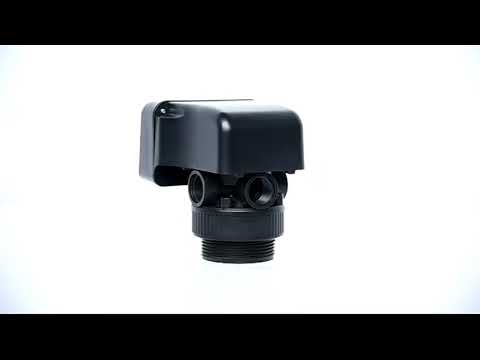
Shanghai ChiMay DIC softener valves feature:
- Programmable capacity settings: 10,000-3,000,000 grains
- Flow meter integration: paddlewheel or magnetic flow sensors
- Multiple regeneration modes: time, flow, or combination control
- Communication options: 4-20 mA, pulse output, Modbus RTU
Meter-Controlled Regeneration
The most sophisticated control approach:
Service Flow Monitoring: Continuous flow measurement tracks cumulative treated water volume.
Predictive Regeneration: Advanced algorithms predict exhaustion based on flow patterns and historical data.
Salt Optimization: Regeneration brine dosage adjusts based on actual demand, pushing salt efficiency toward the ~4,000 grains per pound level regarded as the high-efficiency optimum for ion exchange softening.
Remote Monitoring: Internet connectivity enables fleet management and performance optimization.
System Design Considerations
Capacity Sizing
Proper softener capacity sizing requires analysis of:
Daily Water Usage: Total daily flow requiring softening treatment.
Raw Water Hardness: Inlet hardness concentration determining resin workload.
Target Softness Level: Required outlet hardness specification.
Regeneration Frequency: Desired interval between regenerations (typically 1-7 days).
Capacity Calculation Formula:
Capacity (grains) = Daily Flow (gallons) × Hardness (grains/gallon) × Safety Factor
Example: 10,000 gallons/day at 100 mg/L hardness (5.8 grains/gallon):
Required Capacity = 10,000 × 5.8 × 1.5 = 87,000 grains
Twin-Alternating vs. Single Unit Systems
Single Unit Systems:
- Lower initial investment
- Temporary hardness bypass during regeneration
- Suitable for applications tolerating intermittent hardness
Twin-Alternating Systems:
- Continuous softened water supply (one unit regenerating while other serves)
- Consistent outlet quality
- Extended service intervals
- Higher investment but superior performance
Shanghai ChiMay recommends twin-alternating configuration for semiconductor applications requiring continuous high-quality softened water.
Brine System Design
Effective brine management requires 10-15% sodium chloride concentration, minimum 30 minutes contact time, 40-80 gallons per cubic foot rinse volume, and covered storage for 2-4 weeks supply.
Applications in Electronics Manufacturing
Pretreatment softening reduces hardness by 90-99% to below 10-50 mg/L, protecting downstream RO membranes. Polishing softening achieves <1 mg/L hardness following RO with fine mesh resins operating at high salt efficiency. Point-of-use softening provides dedicated treatment for individual process tools.
Economic Analysis
Softener system operating costs are dominated by salt, regeneration water, and labor. Salt usage is normally planned as pounds of salt per regeneration per cubic foot of resin and then benchmarked as grains-per-pound salt efficiency (see above)—a figure quoted “per 1,000 grains of capacity” mixes units and hides the real driver. Regeneration water typically runs tens of gallons per cubic foot of resin plus a comparable rinse volume. Labor ranges from several hours weekly for manual systems to under an hour monthly for automatic ones.
Optimization investments pay back on payback-period logic rather than fixed dollar figures: DIC control upgrades on a manual valve typically repay in a few years through salt, water, and labor savings; twin-alternating conversion costs more up front but similarly pays back where uninterrupted softened supply has production value; high-efficiency regeneration shaves salt cost proportionally to the efficiency gain. Run the numbers against local salt, water, and labor rates.
DIC twin-alternating systems demonstrate the lowest 10-year TCO for demanding applications.
Installation and Startup
Proper installation requires structural support for resin tank weight, adequate drainage for regeneration wastewater, appropriate electrical supply, and pressure regulation if inlet pressure exceeds 125 psi. Systematic startup includes resin loading with proper settling, complete air elimination, brine system verification, control programming, and performance testing.
Maintenance Best Practices
Systematic maintenance includes weekly salt level inspection, monthly brine system inspection and control valve verification, quarterly resin bed inspection and deep cleaning, and annual resin replacement assessment and complete system overhaul, plus performance benchmarking against capacity tests.
Troubleshooting Common Issues
High Hardness Breakthrough:
- Resin exhaustion → Verify capacity and regenerate
- Channeling → Inspect for air binding or distributor damage
- Improper brine dosage → Verify salt addition and brine system
Excessive Salt Consumption:
- Over-regeneration → Verify demand settings
- Incorrect brine dosage → Calibrate brine valve
- Resin damage → Check for oxidant damage or physical degradation
Regeneration Failures:
- Timer malfunction → Replace timer or control head
- Valve seal wear → Replace seals and inspect valve body
- Drain line blockage → Clear drain and check air break
Future Technology Directions
Smart Softening Systems
Advanced technologies enhance softener performance:
IoT Connectivity: Cloud-based monitoring enables remote performance tracking and alerts.
Machine Learning: AI algorithms optimize regeneration timing based on usage pattern prediction.
Predictive Maintenance: Sensors detect impending component failures before system disruption.
Water Reuse Integration
As facilities increase water recycling:
Softening Role Expansion: Enhanced softening enables greater recycle water utilization.
Brine Recovery: Zero-liquid discharge (ZLD) systems recover brine for beneficial reuse.
Integrated Treatment: Softening becomes part of comprehensive water management rather than a standalone system.
Conclusion
Softener valve selection significantly impacts electronics manufacturing water treatment system performance, operational costs, and product quality. Understanding available technologies, matching capabilities to application requirements, and implementing appropriate maintenance practices ensures optimal system performance throughout equipment life.
Shanghai ChiMay softener valves provide the reliability, efficiency, and control capabilities required for demanding semiconductor and electronics manufacturing applications. With options ranging from simple time-clock control to advanced demand-initiated systems with remote monitoring, these valves enable optimized softening across diverse applications.
As water costs increase and quality requirements intensify, effective water softening assumes increasing importance. Investment in appropriate softener valve technology and systematic maintenance practices delivers substantial returns through reduced operating costs, extended equipment life, and consistent product quality.