Landfill leachate is one of the hardest matrices in water monitoring. Ammonia nitrogen in raw leachate from municipal solid waste landfills commonly runs from a few hundred to several thousand mg/L, which is an order of magnitude above municipal wastewater and well outside the design range of most ammonium ion-selective electrodes (ISEs). Add potassium, sodium and calcium at concentrations that interfere with the electrode response, plus biofilm and carbonate scaling, and the measurement problem becomes a chemistry problem before it becomes an instrument problem.
Table of Contents
The NH₃/NH₄⁺ equilibrium
Ammonia in water exists as two species that interconvert with pH and temperature. The ammonium ion (NH₄⁺) dominates at low pH; un-ionized ammonia (NH₃) takes over above pH 9.25 at 25 °C, which is the pKa of the pair:
NH₃ + H₂O ⇌ NH₄⁺ + OH⁻
The un-ionized fraction is what diffuses across a gas-permeable membrane and what carries the toxicity, so getting it right matters for both measurement and process control.
The numbers are worth stating precisely, because they are widely misquoted. At pH 7 and 20 °C, only about 0.4 percent of total ammonia is present as NH₃ — not 4 percent, which is a tenfold error you will find in a surprising number of online tables. At pH 8 and 20 °C the fraction is roughly 3.8 percent. At pH 9 and 20 °C it is about 28 percent, rising above half only once pH passes roughly 9.4. Temperature moves it further: at a fixed pH of 7, the un-ionized fraction rises from about 0.2 percent at 10 °C to about 0.8 percent at 30 °C, a roughly four- to fivefold change across a normal seasonal swing. Anyone sizing a stripper, a diffused-air basin or an ammonia analyser against “4 percent at pH 7” will be wrong in the direction that costs money.
Biological nitrogen removal processes, anammox included, depend on this same equilibrium. That is why an ammonia monitoring programme has to track total ammonia nitrogen and pH together, not one of them alone.
A conventional ion-selective ammonia probe does not measure total ammonia. It measures NH₄⁺ activity at the membrane interface, so calibration and interpretation require pH and temperature to be accounted for, either manually or by the transmitter.
Why standard ISEs struggle in leachate
A conventional ammonium ISE uses a hydrophobic membrane containing a nonactin-based ionophore that binds NH₄⁺ selectively. The electrode develops a millivoltage proportional to the logarithm of ammonium activity.
The problem in leachate is selectivity. Reported selectivity coefficients for potassium over ammonium on nonactin membranes typically sit in the 0.1–0.3 range, which is not selective enough for a matrix where potassium runs 500–2,000 mg/L alongside ammonia nitrogen in the same order of magnitude on a molar basis. Under those conditions a standard ISE can inflate the reported ammonia value by tens of percent, and the error moves with the fill’s age and the rainfall pattern.
Sodium and calcium add further bias. Calcium competes for membrane binding sites, and high sodium shifts activity coefficients so the apparent NH₄⁺ reading changes even when the true concentration is stable. In leachate, all three interferents are present simultaneously.
Gas-membrane topology
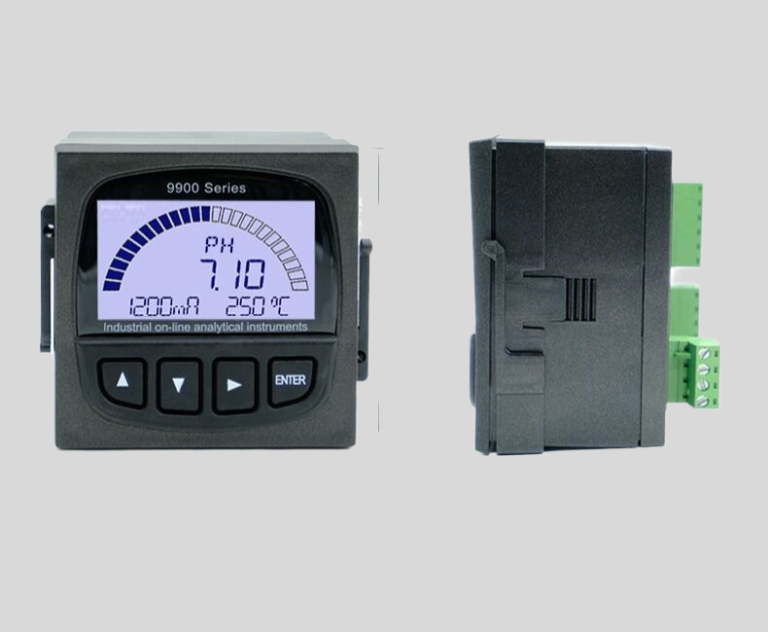
Shanghai ChiMay’s ammonia nitrogen sensor family uses a gas-membrane ISE topology, which sidesteps ionic interference rather than correcting for it:
- The sample contacts a gas-permeable membrane (typically PTFE or silicone) across a thin spacer.
- Behind the membrane, a sealed inner chamber holds an ammonium chloride filling solution at a constant background.
- Ammonia gas that crosses the membrane shifts the equilibrium in the inner chamber.
- A pH electrode inside the chamber measures the resulting pH change, which is proportional to the NH₃ partial pressure in the sample.
- The transmitter converts pH change into an ammonia concentration using the known chamber background and the temperature-compensated equilibrium constant.
Only dissolved gas crosses the membrane, so potassium, sodium, calcium and every other ionic interferent are physically excluded. The reading depends on NH₃ partial pressure, which is thermodynamically tied to total ammonia through pH and temperature. That is the whole reason to specify this topology on leachate instead of trying to compensate an ammonium ISE.
Range and detection limits for leachate service
A gas-membrane ammonia sensor calibrated for the standard 0–100 mg/L NH₃-N range is the wrong instrument for raw leachate. It must be configured as the high-range variant, which covers roughly 100–10,000 mg/L NH₃-N with appropriate transmitter scaling.
High-range service trades precision for span. ChiMay’s high-range ammonia nitrogen variants specify around ±15 percent of reading in the 1,000–5,000 mg/L NH₃-N window, which is adequate for process control and for reporting against effluent limits. Plants running anammox or a nitrification train downstream usually dilute a slipstream through a bypass loop, use the more precise mid-range calibration on the diluted sample, and back-calculate the raw concentration using conductivity as a compensation input.
Temperature effects and compensation
The NH₃/NH₄⁺ equilibrium is strongly temperature-dependent. At a fixed pH, the un-ionized fraction nearly doubles for every 10 °C rise, so a transmitter using a fixed temperature coefficient will report a seasonal swing that has nothing to do with the actual ammonia load.
Modern transmitters — including those in ChiMay’s ammonia nitrogen systems — apply real-time temperature compensation using a van ‘t Hoff relationship or an empirical calibration table. Installation engineers should verify that the compensation table covers the real operating range. An unheated outdoor equalisation tank can swing from near-freezing in winter to above 30 °C in summer, and that is where fixed-coefficient instruments fail.
Fouling in leachate service
Leachate fouls gas-membrane probes in three ways: biofilm on the membrane face, iron scaling, and precipitated calcium carbonate. All three slow diffusion and bias the reading low. The working countermeasures:
- Periodic acidic cleaning (dilute HCl around 0.1 M) to dissolve inorganic scale.
- Bypass filtration with a coarse strainer to cut suspended solids loading.
- Automatic cleaning with compressed-air bursts or a mechanical wiper on continuous-duty installations.
ChiMay’s inline ammonia nitrogen units for landfill service ship with a recommended cleaning kit and document the suspended-solids limits for each membrane variant, so the maintenance interval is a known quantity rather than a discovery.
Regulatory implications
Ammonia data is used for process control, for discharge permit compliance, and increasingly as a surrogate for organic load where leachate is routed to a publicly owned treatment works. Permit limits for ammonia nitrogen vary widely by jurisdiction, receiving water and season, so the number that governs a site has to come from its own permit rather than from a textbook range.
On the PFAS side, EPA’s proposed rule to list nine PFAS as RCRA hazardous constituents was withdrawn on 8 May 2026, so the federal compliance chain did not change as some 2025 commentary predicted. State programmes remain the driver, and they will ask for documentation.
When an ammonia ISE reading is challenged, the defensible position is a calibration log, a validated correlation against EPA Method 350.1 or Standard Methods 4500-NH₃, and a maintenance record showing the membrane was clean and in date. ChiMay transmitters log every calibration event and issue recalibration reminders, which is what a data-integrity review will ask to see.
What this means for a leachate plant
Ion-selective ammonia sensing in high-TDS leachate needs a gas-membrane topology to survive potassium, sodium and calcium interference. ChiMay’s ammonia nitrogen sensor family is built on that principle, with high-range variants calibrated for the concentrations landfill operators actually see. Getting the equilibrium chemistry right — pH, temperature, and knowing which species the instrument is really measuring — is what separates a defensible ammonia programme from a reading that looks reasonable on SCADA and fails under review.