Table of Contents
Introduction
pH represents the most influential parameter in water treatment. It determines whether water corrodes metals or precipitates scales, influences reaction rates, and controls microbiological growth. Understanding pH science enables operators to optimize treatment programs and extend equipment life.
Understanding pH Fundamentals
What Is pH?
pH measures hydrogen ion (H⁺) concentration on a logarithmic scale:
pH = -log₁₀[H⁺]
Each unit change represents a 10-fold change in hydrogen ion concentration.
The pH Scale
Acidic ←───────────────────────→ Alkaline
     |     |     |     |     |     |
     0     2     4     6     8    10    12    14
           |           |           |
      Battery   Neutral   Household
       Acid     Water     Ammonia
Water Autoionization
H₂O ⇌ H⁺ + OH⁻
At 25°C: [H⁺] = [OH⁻] = 10⁻⁷ M
Kw = [H⁺][OH⁻] = 10⁻¹⁴
Why pH Matters in Water Treatment
pH and Corrosion
As pH drops below the optimal band for a given metallurgy, corrosion rates climb—slowly at first, then sharply, as abundant hydrogen ions accelerate cathodic reactions. The magnitude depends on the system, but the trend is monotonic and unforgiving.
pH and Scaling
As pH increases above 8.3, bicarbonate converts to carbonate, driving calcium carbonate precipitation. The Langelier Saturation Index (LSI) quantifies scaling tendency:
- LSI > +0.5: Scaling will occur
- LSI < -0.5: Corrosion tendency
pH and Microbiological Activity
Most microorganisms thrive at pH 6.0-8.5. Industrial systems target 7.5-8.2 to minimize both biological growth and corrosion/scaling.
Measuring pH Accurately
Glass Electrode Technology
Modern electrodes feature:
- Low-impedance glass: Faster response
- Double junction reference: Prevents contamination
- Automatic temperature compensation (ATC): Accuracy across ranges
- Solid-state reference: Longer life
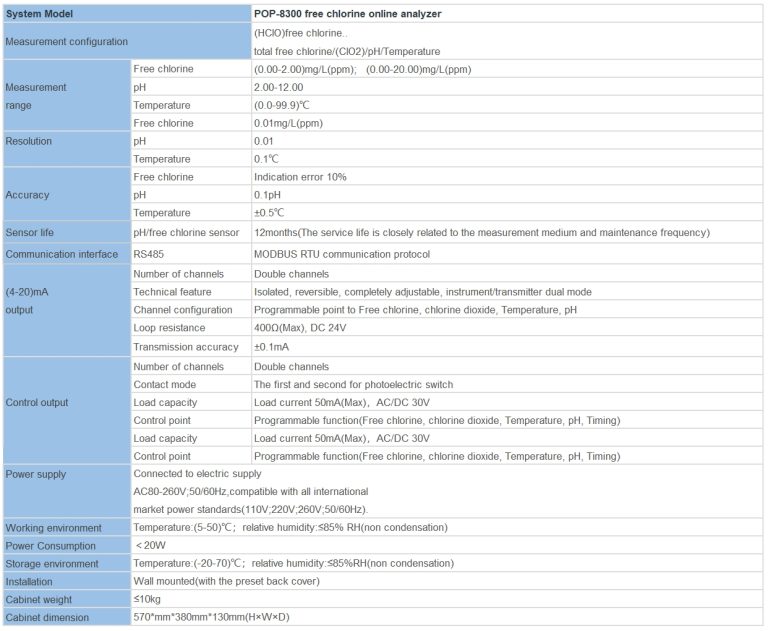
Shanghai ChiMay’s pH electrodes feature differential measurement achieving ±0.02 pH accuracy with 12+ month maintenance intervals.
Temperature Effects
Nernst equation temperature dependence:
E = E₀ – (2.303 × RT/F) × pH
| Temperature | Slope |
|---|---|
| 5°C | 55.2 mV/pH |
| 25°C | 59.2 mV/pH |
| 50°C | 64.1 mV/pH |
The theoretical Nernst slope is approximately 54.2 mV/pH at 0°C and rises with absolute temperature—this is why automatic temperature compensation is not optional in outdoor or hot-process service.
Calibration Standards
| Buffer pH (25°C) | Primary Use | Tolerance |
|---|---|---|
| pH 4.00 | Acidic solutions | ±0.01 |
| pH 7.00 | Neutral point | ±0.01 |
| pH 10.00 | Alkaline solutions | ±0.01 |
Industry standards recommend:
- Two-point calibration minimum
- Daily verification against one buffer
- 30-day full calibration
Controlling pH in Industrial Systems
Chemical Dosing Methods
Acid Dosing
| Acid | Concentration | Advantages | Disadvantages |
|---|---|---|---|
| Sulfuric (H₂SO₄) | 93-98% | Low cost | Exothermic |
| Hydrochloric (HCl) | 32-37% | Fast acting | Chloride attack |
| Citric | 50% | Safe handling | Higher cost |
Alkali Dosing
| Alkali | Concentration | Advantages | Disadvantages |
|---|---|---|---|
| Sodium hydroxide | 50% | Fast acting | Caustic burns |
| Potassium hydroxide | 45% | No sodium | Higher cost |
| Soda ash | Powder | Safe handling | Slow dissolution |
Control System Design
Feedback control:
Setpoint → Controller → Dosing Pump → Process
    │                                  │
    └──────── Sensor ←─────────────────┘
Advanced feedforward + feedback:
Setpoint → Controller → Dosing Pump → Process
    │                                  │
    └──────── Sensor ←─────────────────┘
         ↑
    Flow → Feedforward Calculator
| Control Method | Typical Accuracy | Stability |
|---|---|---|
| Manual dosing | ±0.5 pH | Poor |
| Time-based dosing | ±0.3 pH | Fair |
| Feedback control | ±0.1 pH | Good |
| Feedforward + feedback | ±0.05 pH | Excellent |
Application-Specific Control
Cooling Tower Systems
Control strategy:
1. Monitor basin pH continuously
2. Maintain acid/alkaline reserve for buffering
3. Control blowdown to manage concentrations
4. Adjust for seasonal variations
Boiler Feedwater Systems
| Boiler Pressure | Target pH | Chemical Used |
|---|---|---|
| < 150 psi | 10.0-10.5 | NaOH, phosphate |
| 150-600 psi | 10.0-10.5 | Phosphate only |
| > 600 psi | 9.8-10.2 | All-volatile treatment |
Reverse Osmosis Systems
RO membranes operate at pH 2-11, with optimal scale control at 6.5-7.5.
Troubleshooting pH Control
| Problem | Likely Cause | Solution |
|---|---|---|
| pH cycling | Over-dosing | Increase deadband, tune |
| Slow response | Fouled electrode | Clean or replace |
| Drift | Reference contamination | Clean junction |
| Readings stuck | Air bubbles | Remove bubbles |
| Wild readings | Ground loops | Check grounding |
Electrode diagnostic tests:
1. Slope test: Should be 95-102% (59.2 mV/pH at 25°C)
2. Offset test: Should be < 30 mV at pH 7
3. Response time: 95% in < 30 seconds
Safety Considerations
Acid Handling
- PPE: Face shield, acid-resistant gloves, apron
- Emergency eyewash within 10 seconds
- Secondary containment for storage
- Proper ventilation for HCl
Alkali Handling
- PPE: Face shield, rubber gloves
- Emergency eyewash access
- NEVER add water to concentrated NaOH
Conclusion
Effective pH control delivers benefits that show up across the plant: fewer corrosion-related failures, fewer scaling-related losses, and treatment chemical spend that goes into the water instead of down the drain. The exact savings depend on the system and how poorly it was controlled before.
Shanghai ChiMay’s pH measurement solutions provide:
– In-line electrodes with differential technology
– Transmitters with automatic calibration
– Integrated multi-parameter systems
– Modbus RTU/TCP and 4-20 mA integration
These instruments enable tight pH control that protects equipment, optimizes treatment, and reduces operational costs.