Table of Contents
The Historical Model and Why It Worked—Until It Didn’t
For most of the past century, cooling tower water treatment followed a straightforward formula: add biocide, add scale inhibitor, add corrosion inhibitor, test the water periodically and adjust doses based on laboratory results. This chemical-only approach was good enough to keep industrial operations running, and it became the default methodology across power generation, manufacturing, HVAC and process cooling applications.
The model worked because chemical costs were relatively low, environmental regulations were less stringent, and water was abundant. In that context, over-treating the water was cheaper than under-treating it, and the occasional scaling or corrosion event was accepted as an operational cost.
But three structural shifts have changed the economics.
Shift 1: Chemical Costs Have Climbed Steadily
The global water treatment chemicals market is worth tens of billions of dollars a year, and market researchers—Grand View Research among them—expect it to keep growing through 2030. The report-to-report details vary, but plant-level experience is unambiguous: chlorine-based biocides, phosphonate scale inhibitors and azole corrosion inhibitors have all gotten more expensive over the past few years, driven by raw material costs, energy prices and supply constraints.
Scale that against a large industrial tower consuming 500 kg of treatment chemicals a month, and a 20% price increase stops being an abstraction—it lands directly on the annual operating budget. That pressure alone pushes facilities to optimize dosing rather than running conservative over-doses as insurance against uncertainty.
Shift 2: Discharge Regulations Are Tightening
Cooling tower blowdown—the intentional discharge of concentrated recirculating water—carries dissolved chemicals, heavy metals and biocide residuals into receiving waterways, and regulators keep tightening what they will accept. There is no single global blowdown rule, but the direction is consistent everywhere. In the U.S., blowdown limits come through site-specific NPDES permits, with federal effluent limitations guidelines for steam electric plants (40 CFR Part 423) setting the floor for the power sector. EU industrial installations face comparable pressure through BAT conclusions under the Industrial Emissions Directive, and regulators in Australia, China and Southeast Asia are tightening their own discharge standards.
Chemical-only programs that dose on a fixed schedule, regardless of actual water quality, routinely over-apply chemicals to keep a treatment margin. That over-application is exactly what pushes blowdown concentrations past permit limits—and turns a water management problem into a compliance problem.
Shift 3: Sustainability Mandates Demand Efficiency
Corporate sustainability commitments and ESG reporting frameworks now include water stewardship metrics. The Alliance for Water Stewardship (AWS) Standard, CDP Water Security disclosures and individual corporate net-water-use targets all require facilities to demonstrate measurable progress in water efficiency. Chemical-only programs with no continuous monitoring capability cannot produce the data needed to substantiate water efficiency claims.
What Replaces Chemical-Only Programs
The alternative is not eliminating chemicals—it is applying them intelligently based on continuous water quality data. Sensor-driven cooling tower programs use real-time pH, conductivity, ORP and turbidity measurements to modulate chemical feed rates in response to actual conditions rather than predetermined schedules.
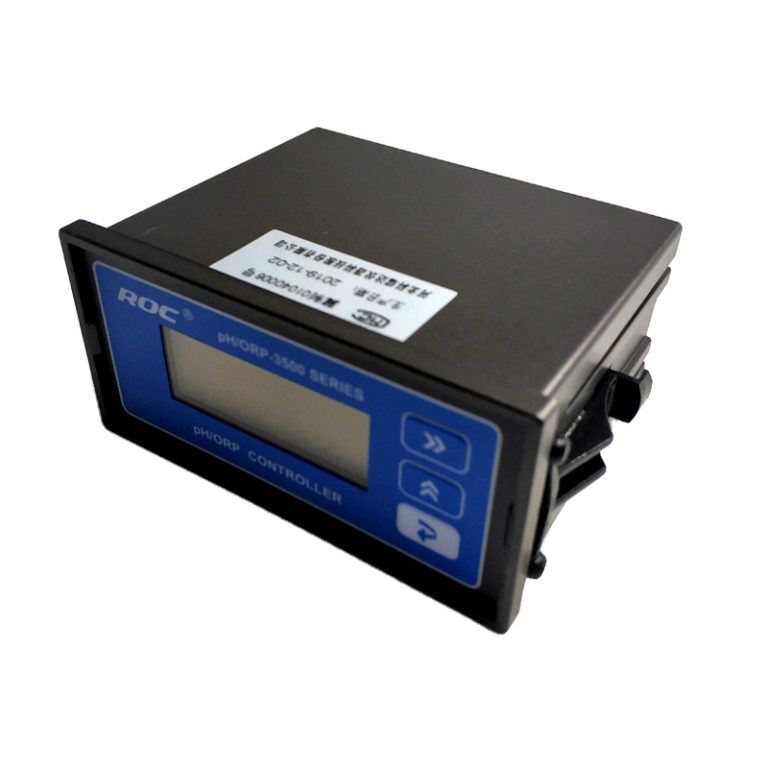
Shanghai ChiMay’s sensor instruments form the foundation of these programs. The in-line conductivity meter tracks cycles of concentration and triggers blowdown at the optimal point. The in-line pH electrode monitors chemistry balance and triggers acid or alkali dosing to maintain target pH. The ORP sensor validates microbiological control and modulates oxidant feed. The online turbidity tester detects particulate events that may indicate biofilm sloughing or make-up water quality changes.
Connect these sensors to automated chemical feed controllers and the program applies the right amount of chemical at the right time—no more, no less. That is the fundamental difference between chemical-only and sensor-driven programs.
The Numbers Behind the Transition
The economic case is easiest to see in the field. A textile manufacturing facility in Guangdong Province, China, switched from a chemical-only program to a sensor-based approach built on Shanghai ChiMay instruments in early 2025. Over the following 12 months, chemical consumption dropped by roughly a third, blowdown volume fell in step, and approach temperature improved measurably. The sensor package paid for itself within a few months.
A district cooling facility in the Middle East reported similar results after moving to ChiMay’s multi-parameter monitoring platform. Continuous conductivity control pushed cycles of concentration well beyond their previous operating point, cutting both make-up water demand and blowdown discharge substantially.
Why the Transition Is Accelerating Now
The shift from chemical-only to sensor-driven programs has been underway for years, and 2026 is shaping up as the year it tips. Three factors are converging: sensor costs have dropped to the point where continuous monitoring is economically viable for facilities of all sizes, regulatory agencies increasingly want continuous data rather than periodic grab samples as evidence of compliance, and corporate ESG commitments create internal pressure for measurable water stewardship improvements.
Facilities still operating chemical-only programs are accumulating a competitive disadvantage: higher chemical spend, higher water consumption, elevated compliance risk, and no data to back up sustainability claims. The remaining question is not whether to make the switch—it is how much the wait costs.
Shanghai ChiMay provides the sensor infrastructure facilities need for this transition—from in-line pH electrodes and conductivity meters to ORP sensors, turbidity testers and multi-parameter platforms. The data these instruments produce is the foundation of modern, efficient, compliant cooling tower water treatment.