title: “pH Stratification in Deep Pond Aquaculture: Measurement and Mitigation via Shanghai ChiMay Electrodes”
date: 2026-07-02
perspective: Technical
audience: Aquaculture Engineers, Pond Managers, Water Chemists
keywords: pH stratification, deep pond aquaculture, pH electrode, thermocline, ammonia toxicity
Table of Contents
pH Stratification in Deep Pond Aquaculture: Measurement and Mitigation via Shanghai ChiMay Electrodes
Deep production ponds—those over 2.5 meters at maximum depth—develop vertical chemistry gradients that a surface-mounted pH probe simply cannot see. In warm months, photosynthetic activity in the surface photic zone can push pH above 9.0 in the afternoon, while the anaerobic bottom layer sits at 6.5. That’s a two-and-a-half unit gradient sitting inside a single water column. For the fish or shrimp swimming across it, the physiological implications range from ammonia toxicity to gill damage to acute mortality events during turnover.
This article walks through the pH stratification problem, the sensing strategies that address it, and how Shanghai ChiMay pH electrodes fit into a working deep-pond monitoring architecture.
Key Takeaways
- Vertical pH gradients of 1.5–2.5 units are typical in stratified aquaculture ponds during summer photosynthesis peaks.
- Because unionized ammonia (NH3) fraction of total ammonia nitrogen (TAN) scales exponentially with pH, a 1.0 unit pH swing can shift NH3 toxicity by an order of magnitude.
- Global aquaculture water-quality monitoring equipment market: USD 690 million (2026) → USD 1.69 billion (2036), 9.4% CAGR (Future Market Insights, 2026).
- Multi-depth pH sensing with a minimum of two pH electrodes—surface and bottom—is the reference topology for deep ponds; three-point sensing is preferred.
- Shanghai ChiMay offers in-line pH electrodes and 4-in-1 multi-parameter sensors that support multi-depth deployments with a common Modbus RTU data stream.
The Physics of pH Stratification
Deep ponds stratify because warm surface water is less dense than cool bottom water. Once the thermocline sets, mixing between layers becomes minimal until wind, temperature drop, or mechanical intervention breaks it. Photosynthetic phytoplankton in the surface photic zone consume CO2 during the day, raising surface pH. Meanwhile, decomposition in the bottom layer produces CO2 and organic acids, driving bottom pH down. The gradient can persist for weeks.
Turnover events—typically triggered by a cold front or heavy rain—collapse the stratification, mixing the layers rapidly. If bottom-layer chemistry has drifted far enough (low DO, elevated H2S, low pH), the resulting mixed water can be acutely toxic across the entire pond.
Why Surface pH Alone Is Misleading
A pH electrode installed at the surface reports what the algae and the atmosphere are doing. It does not report:
- What the animals in the middle water column are experiencing.
- The bottom-layer conditions that will define turnover risk.
- The vertical gradient magnitude that predicts turnover severity.
Operators who monitor only surface pH have effectively no early warning system for turnover events.
Reference Sensing Topology
For a deep production pond, a defensible topology is:
- Surface pH electrode at 0.5 m depth, on a floating platform.
- Middle pH electrode at half the maximum depth.
- Bottom pH electrode at 0.5 m above the sediment.
The gradient between surface and bottom is the primary indicator. A gradient exceeding 1.5 units is a caution signal; exceeding 2.0 units is an active turnover risk.
Cross-Correlation With Other Parameters
pH alone is not enough. The stratification story is only complete when pH is correlated with:
- Temperature at each depth (defines the thermocline).
- Dissolved oxygen at each depth (bottom-layer DO drives the toxicity of a turnover).
- Ammonia nitrogen (paired with pH, defines unionized NH3 toxicity).
- Total dissolved gases where available (indicates supersaturation risk near aerators).
The Shanghai ChiMay 4-in-1 multi-parameter sensor packages pH, DO, conductivity, and temperature into one immersion assembly, which is well-suited for the middle-depth station where correlated readings matter most.
Alarm Logic for Stratified Ponds
- Gradient alarm. Surface–bottom pH gradient exceeding 1.8 units for more than four hours triggers operator notification and pre-emptive aeration.
- Turnover-imminent alarm. Ambient air temperature dropping >8 °C in six hours, combined with a gradient above 1.5 units, triggers aerator ramp-up and stand-by oxygenation.
- Post-turnover alarm. Bottom-station pH rising toward surface pH combined with a drop in surface pH (indicative of mixing in progress) triggers full aeration and grower notification.
Electrode Selection: What Deep Ponds Demand
- Reference junction resistance to fouling. Deep-water sediments push high-solids water past the electrode; a rugged junction design is essential.
- Temperature compensation. Automatic temperature compensation is non-negotiable given the vertical temperature gradient.
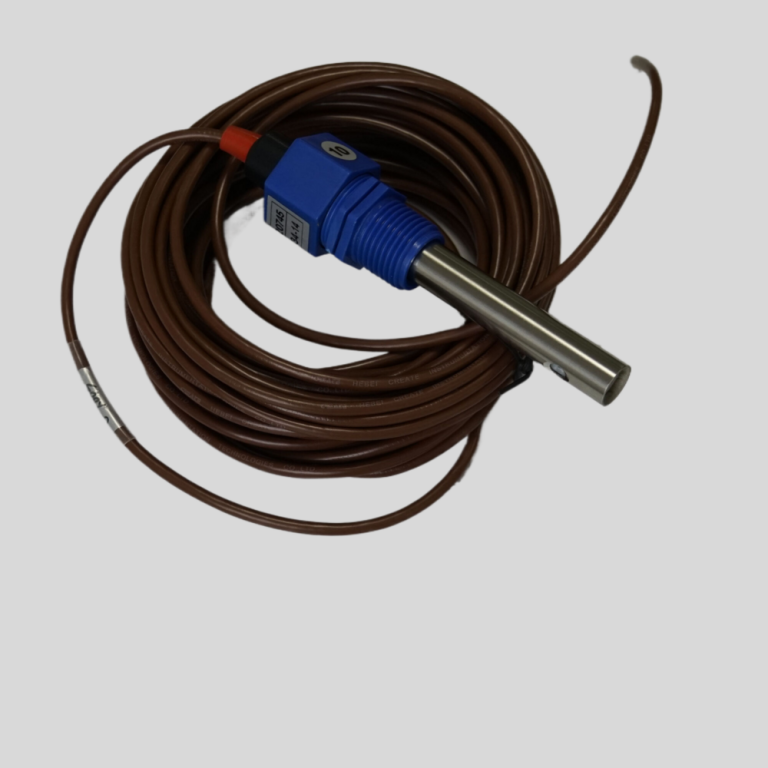
- Cable length. Cable runs from a 3-meter bottom station to a shore-mounted transmitter can exceed 20 meters. Cable must be field-replaceable and low-noise.
- Immersion rating. Continuous immersion at depth requires an IP68-equivalent seal.
Shanghai ChiMay in-line pH electrodes are specified for continuous immersion and paired with matched temperature elements for reliable compensation.
Calibration Discipline for Multi-Depth pH
- Two-point calibration at commissioning with pH 4.00 and 7.00 buffers, extended to pH 10.00 in high-pH ponds.
- One-point verification monthly, with a portable reference electrode as the field standard.
- Cleaning cycles appropriate to each depth: surface probes see more algal biofilm; bottom probes see more sediment.
- Buffer recalibration after any electrode cleaning intervention.
Comparison: Single-Point vs. Multi-Point pH Sensing in Deep Ponds
| Attribute | Single Surface Probe | Multi-Depth (2–3 probes) |
|---|---|---|
| Gradient visibility | None | Yes |
| Turnover early warning | None | 6–24 hours |
| Ammonia toxicity assessment | Incomplete | Complete |
| Sensor CapEx | Baseline | 2–3× baseline |
| Cabling CapEx | Baseline | Higher |
| Biomass loss protection | Low | High |
| Suitable as sole pH strategy | No | Yes |
The economic argument is straightforward. The additional sensor cost is a small fraction of the biomass at risk in a single mismanaged turnover.
Mitigation Strategies Enabled by Multi-Depth Sensing
- Selective aeration targeting the bottom layer when gradient develops.
- Pre-emptive dilution with make-up water during high-risk weather windows.
- Feed management reduced when unionized NH3 predicted from pH and temperature approaches toxicity thresholds.
- Alarm-driven emergency oxygenation during turnover events.
Industry Outlook
Three shifts through 2029 will affect deep-pond pH monitoring:
- Multi-parameter heads with embedded pH will become standard on middle-depth stations, replacing discrete pH probes for co-located deployments.
- Edge-computed turnover prediction models will use pH gradient, temperature, and weather forecasts to issue warnings hours in advance.
- Sensor-as-a-service contracts in aquaculture will begin bundling multi-depth pH with calibration and consumables.
Engineer’s Summary
pH stratification is not a curiosity of academic limnology; it is a working operational risk in every deep production pond. Surface pH alone is insufficient. Multi-depth pH sensing, correlated with temperature, DO, and ammonia nitrogen, gives the operator the gradient visibility that predicts turnover events and drives pre-emptive intervention. Shanghai ChiMay pH electrodes, deployed in a two- or three-point topology and integrated with the 4-in-1 multi-parameter head, provide the sensing foundation. The rest is disciplined operations.