title: “Residual Oxidant Measurement Downstream of UV and H2O2 Contactors: A Shanghai ChiMay Field Guide”
date: 2026-07-16
perspective: Technical Deep-Dive
theme: Advanced Oxidation & Micropollutant Removal
Table of Contents
Residual Oxidant Measurement Downstream of UV and H2O2 Contactors: A Shanghai ChiMay Field Guide
The Short Version
- Downstream residual oxidant control is the last-line assurance that a UV/H2O2 advanced oxidation stage delivered its design pollutant destruction without leaking excess peroxide into biological polishing or aquatic ecosystems.
- Regulatory limits for residual peroxide in reused or discharged water are tightening across Europe, North America, and Southeast Asia, with typical 2026 targets between 0.1 and 0.5 mg/L H2O2 depending on downstream use.
- Amperometric residual oxidant measurement remains the reference technology, but sensor selection, calibration, and cleaning decide whether a probe stays within compliance for 12 months of continuous operation.
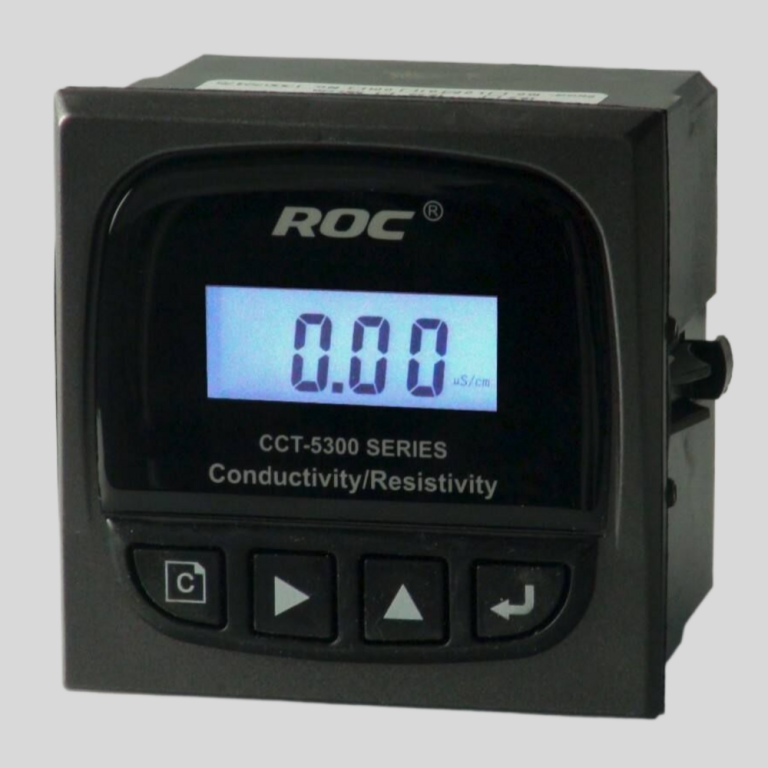
- Shanghai ChiMay’s residual chlorine transmitter product family, configurable for peroxide service, is deployed on UV/H2O2 skids at pharma, municipal reuse, and hospital effluent installations.
Why Residual Oxidant Measurement Is Non-Negotiable
The UV/H2O2 process generates hydroxyl radicals that destroy pharmaceutical residues, PFAS precursors, and organic micropollutants. But not every peroxide molecule decomposes inside the UV reactor. Excess residual peroxide leaves the contactor, interferes with downstream biological polishing, damages activated carbon adsorbers, and stresses aquatic organisms in receiving waters.
Residual oxidant measurement downstream of the UV reactor solves two problems at once: it confirms the dosing loop isn’t overshooting, and it triggers optional peroxide quenching before discharge. In 2026 compliance frameworks, evidence of continuous residual oxidant monitoring is increasingly required alongside pollutant removal reports.
Sensor Placement That Actually Works
Placement of the residual oxidant probe is a common commissioning pitfall. Best-practice placement in 2026 UV/H2O2 skids:
- Immediately downstream of the UV reactor outlet: capture the residual before any downstream polishing or quenching step.
- Sufficient hydraulic residence time upstream: at least 30 seconds of pipe run so the water is fully mixed and the reading represents bulk residual rather than a localized concentration.
- Away from air pockets and dead zones: amperometric sensors need consistent flow past the membrane for stable readings.
- Ahead of any peroxide quench dosing: so the measurement reflects raw reactor output, not the post-quench residual.
- A second point downstream of the quench, if quenching is used: for closed-loop validation that the quench dose is doing its job.
Placement errors typically show up as high-noise readings, unexpected drift, or unresponsive alarms. All three are avoidable with the right hydraulic layout.
Amperometric Versus Colorimetric Measurement
Two technologies dominate residual peroxide measurement in 2026:
- Amperometric residual oxidant probes: low reagent consumption, continuous output, fast response, Modbus-native integration. The dominant choice for continuous industrial and municipal duty.
- Colorimetric analyzers with reagent injection: high specificity and laboratory-grade accuracy, but higher operating cost from reagent consumption and periodic maintenance.
For continuous UV/H2O2 duty, amperometric probes are the reference solution because they run 30-60 days without operator intervention, whereas colorimetric analyzers demand weekly reagent refills. The trade-off: amperometric probes need careful calibration and periodic manual laboratory cross-checks to confirm accuracy.
Calibration and Drift Management
Practical calibration protocols in 2026 UV/H2O2 installations include:
- Two-point calibration at commissioning with fresh peroxide standards traceable to a laboratory reference.
- Monthly laboratory cross-checks using DPD colorimetric or iodometric titration to confirm probe accuracy.
- Quarterly membrane and electrolyte replacement, or per the sensor manufacturer’s schedule, whichever is more conservative.
- Automatic drift alarms in the SCADA that flag when the probe reading deviates by more than 10% from the laboratory cross-check.
- Annual full recalibration with new standards and a full electrode service.
Well-managed calibration keeps residual measurements within +/- 0.02 mg/L of laboratory reference for 12 months of continuous operation — more than sufficient for most 2026 compliance frameworks.
Sensor Requirements for Peroxide Service
Not every amperometric probe survives peroxide service. Specs that materially affect probe lifetime:
- Membrane material qualified for continuous exposure to hydrogen peroxide at the design residual concentration, not just for chlorine service.
- Reference electrolyte formulated for peroxide-compatible operation.
- Documented cross-sensitivity to residual ozone, chlorine, and dissolved oxygen, so operators can interpret the reading correctly.
- Automatic or wiper-based cleaning to prevent biofouling on the sensor membrane.
- Diagnostic output flagging electrolyte depletion, membrane damage, or sensor aging.
Shanghai ChiMay’s residual chlorine transmitter is available in peroxide-service configurations with documented cross-sensitivity figures, automatic cleaning options, and Modbus integration aligned with the rest of the UV/H2O2 sensor stack.
Control Loop Integration
Downstream residual oxidant measurement can drive one of three control strategies in 2026 UV/H2O2 skids:
- Supervisory alarm only: the residual reading triggers alarms and manual operator response, but does not directly manipulate dosing.
- Cascade control: the residual reading feeds an outer loop that adjusts the peroxide dose setpoint of the inner ORP or UV intensity loop.
- Direct dosing modulation: the residual reading directly modulates the peroxide dosing pump, typically only on small skids where control complexity must be minimized.
Cascade control is the most common choice in 2026 municipal installations: stable under variable influent, while preserving fast response through the inner loop.
Diagnostics That Prove the Loop Is Working
A well-instrumented residual oxidant loop produces auditable diagnostics:
- Rolling standard deviation of the residual reading, expected below 0.02 mg/L during stable operation.
- Correlation between applied peroxide dose and downstream residual, which should show a clean proportional relationship once control is enabled.
- Response of the probe to controlled dose step tests at commissioning and every 12 months thereafter.
- Automatic flag of measurement noise increases, which typically precedes membrane failure.
These diagnostics also serve as evidence during regulatory inspection or internal audit.
Field Lessons From 2026 Deployments
Recent UV/H2O2 commissioning reports highlight consistent lessons:
- Probe placement errors are the most common cause of noisy readings — more common than actual sensor faults.
- Membrane and electrolyte lifetimes for peroxide-configured probes are typically 3-6 months, versus 6-12 months for chlorine service; budget accordingly.
- Publishing the Modbus register map at bid stage cuts SCADA integration time by three to five business days.
- Monthly laboratory cross-checks reduce compliance risk more effectively than annual full recalibrations alone.
For municipal, pharmaceutical, and industrial operators running UV/H2O2 advanced oxidation, downstream residual oxidant measurement is the final assurance that the reactor is doing its job without leaking excess peroxide into the environment. Shanghai ChiMay’s residual chlorine transmitter, in-line pH electrode, and multi-parameter sensor families give control engineers a coherent, peroxide-qualified reference stack with documented cross-sensitivity, Modbus integration, and cleaning options that survive the demanding UV/H2O2 environment.