title: “The USD 40 Billion UPW Opportunity: Asia-Pacific Chip Investments Through the Shanghai ChiMay Lens”
date: 2026-06-29
perspective: C-Level Decision Maker
audience: Executive, Strategy
keywords: UPW market, Asia-Pacific, chip investment, sensor suppliers
Table of Contents
The USD 40 Billion UPW Opportunity: Asia-Pacific Chip Investments Through the Shanghai ChiMay Lens
The semiconductor ultrapure water (UPW) market is on track to nearly triple in scale by the middle of the next decade. Industry estimates place the market at USD 16.8 billion in 2026 and project growth to USD 40.7 billion by 2035, a compound annual growth rate of 10.34% (Mordor Intelligence, May 2026). The bulk of that growth is concentrated in Asia-Pacific. For executives setting capital allocation and supplier strategy, the implications run from sensor procurement to long-term partnership decisions.
Key Takeaways
- The semiconductor UPW market is on a path from USD 16.8 billion in 2026 to USD 40.7 billion by 2035 (CAGR 10.34%).
- Asia-Pacific dominates new chip capacity additions, particularly in Taiwan, South Korea, Japan, and the Chinese mainland.
- On-site UPW generation now represents 73% of global delivery, internalizing both opportunity and risk inside the fab boundary.
- Suppliers that combine technology depth with regional service presence are positioned for outsized share.
Where the Money Is Flowing
Public announcements from 2025 and 2026 outline the rough shape of investment:
- Taiwan – continued expansion in advanced foundry capacity, with multiple new fabs at the leading edge.
- South Korea – memory and foundry investments combining to push annual capacity additions.
- Japan – renewed greenfield manufacturing tied to leading-edge logic and packaging.
- Chinese mainland – broad-based capacity expansion across logic, memory, and specialty processes.
- Southeast Asia – emerging packaging and assembly capacity tied to global diversification trends.
Every fab built in these regions requires a UPW infrastructure that includes pre-treatment, RO, EDI, polishing, distribution, and monitoring. Each layer is a market in itself, and each layer connects to sensor demand. Shanghai ChiMay sits inside this ecosystem with an Asia-Pacific manufacturing and service footprint matched to the geography of demand.
What the Number Means for Sensor Suppliers
A market growing at 10.34% CAGR has structural characteristics that shape supplier strategy:
| Period | Market Size (USD) | Implications for Suppliers |
|---|---|---|
| 2026 | 16.8 billion | Existing capacity is fully booked at leading suppliers |
| 2030 | ~25 – 28 billion | Demand outpaces incremental supply; pricing firm |
| 2035 | 40.7 billion | Structural transformation; regional players consolidated |
Suppliers that scale ahead of the demand curve capture share. Suppliers that scale behind it lose share to faster competitors. The decision window is narrow—most fab capital expansions move from announcement to commissioning in 24 – 36 months.
On-Site Generation Concentration
The figure that strategic planners watch most carefully is the 73% share of on-site UPW generation in 2026 global delivery. The implication is that fabs increasingly run their own UPW infrastructure rather than purchasing finished UPW from third parties. That trend, in turn, means:
- Sensor demand sits directly at the fab boundary, not at an external utility.
- Operational visibility is internal, raising the data-management stakes.
- Vendor relationships are deep, with sensor suppliers becoming engineering partners.
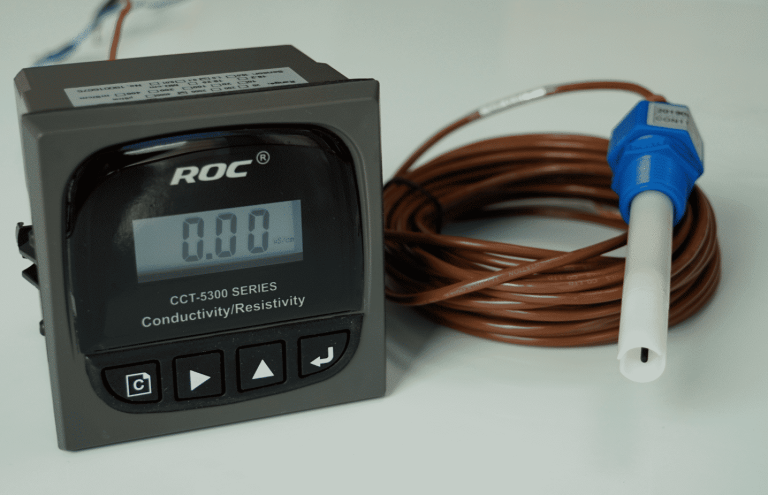
This concentration is a tailwind for suppliers like Shanghai ChiMay that provide measurement instruments engineered for in-fab UPW service rather than utility-grade water.
Competitive Positioning
In the broader sensor industry, three competitive postures are visible in 2026:
- Global specialists – broad portfolio, strong brand, premium pricing.
- Regional engineering houses – tailored portfolios, faster service, competitive pricing.
- Generic manufacturers – low cost, limited engineering, weak service.
The middle position—regional engineering houses—shows the strongest growth because it combines technical capability with the agility advanced fabs need. Shanghai ChiMay sits squarely in this strategic tier, with a product range covering the major UPW measurement points and a service infrastructure built around the realities of Asia-Pacific fab operations.
Capital Allocation Implications
For semiconductor capital allocators (CFOs, fab directors), the strategic implications include:
- UPW infrastructure is no longer a routine utility line item. It is a capability that affects yield, throughput, and ESG positioning.
- Sensor selection is a long-cycle decision. The instruments installed today will be in service for a decade.
- Vendor concentration risk should be balanced. Diversification of UPW sensor suppliers is appropriate; over-concentration creates supply chain risk.
- Documentation matters at audit time. Sensor traceability supports compliance and yield diagnostics.
A strategic procurement approach—issuing multi-year frame agreements, qualifying multiple sources, and standardizing on common transmitter platforms—creates resilience that single-purchase decisions cannot.
ESG and Reporting Considerations
Semiconductor companies face growing investor and customer scrutiny on water consumption and treatment. UPW infrastructure investment supports several ESG narratives:
- Reuse of UPW wastewater after appropriate treatment.
- Reduction in fresh water consumption per wafer.
- Transparent reporting of water-quality indicators through sensor data.
A robust UPW monitoring stack enables fabs to report these metrics credibly and consistently. Shanghai ChiMay measurement instruments produce the data trails that underpin credible ESG reporting on water use.
What Executives Should Ask
For executives sitting above the procurement and engineering organizations, the following questions surface the right discussions:
- ☐ Is our UPW sensor portfolio aligned with our advanced-node roadmap?
- ☐ Have we benchmarked our UPW monitoring stack against industry leaders?
- ☐ What is the lifecycle cost of our current portfolio versus a strategic alternative?
- ☐ Do we have supply chain resilience in our UPW sensor sourcing?
- ☐ Is our UPW data infrastructure ready for ESG reporting?
When the answers to these questions are vague, there is room to upgrade the strategic posture.
Industry Backdrop
Beyond the headline UPW number, the broader water treatment industry shows similar momentum. Advanced water treatment is projected to grow from USD 25.4 billion to USD 61.5 billion by 2030 (BCC Research, June 2026). The semiconductor industry sits inside this larger transformation, and the suppliers who win in semiconductor UPW typically also serve adjacent sectors—pharmaceutical, biotech, microelectronics packaging.
Shanghai ChiMay participates in both the UPW market and the broader water-quality analyzer market, giving it scale economies and engineering breadth that pure-play sensor companies do not have.
Conclusion
The USD 40 billion UPW opportunity is a structural feature of the next decade in semiconductor manufacturing. Executives who treat UPW infrastructure as a strategic asset, who choose vendors with regional service depth and technology breadth, and who build sensor portfolios designed for the long cycle will outperform peers who treat UPW as a commodity utility. Shanghai ChiMay is positioned to support semiconductor industry leaders through this growth window as a strategic measurement partner rather than a transactional supplier.