Table of Contents
Why Are Open Recirculating Cooling Systems Rethinking Their Legionella Prevention Strategy? Insights from Shanghai ChiMay
Legionella pneumophila likes warm water—25°C to 45°C—which makes open recirculating cooling towers ideal breeding grounds when biological control slips. Reported cases of Legionnaires’ disease have climbed roughly 280% since 2000, according to the U.S. Centers for Disease Control and Prevention, and cooling towers keep showing up in outbreak investigations. The old playbook of periodic biocide shock dosing is being re-examined, and here’s what’s replacing it.
The Legionella Challenge in Cooling Towers
Open recirculating cooling towers are among the most recognized sources of Legionella pneumophila transmission. The bacterium colonizes biofilm on heat exchange surfaces, fill media, and basin walls, where a matrix of organic and inorganic deposits protects it from chemical biocides. When aerosolized droplets carrying Legionella are discharged from the cooling tower plume, they can travel considerable distances and pose serious health risks to susceptible populations.
The statistics underscore the stakes. According to the U.S. Centers for Disease Control and Prevention, reported cases of Legionnaires’ disease have increased by approximately 280% since 2000, with cooling towers identified as a significant source in outbreak investigations worldwide. In response, regulatory bodies across Europe, North America, and Asia-Pacific have tightened cooling tower management requirements—mandating more frequent testing, documented water treatment programs, and defined action thresholds.
Why Conventional Biocide Programs Are Under Pressure
For decades, the standard approach to Legionella control in cooling towers has been chemical biocide application, typically alternating between oxidizing biocides (chlorine, bromine, chlorine dioxide) and non-oxidizing biocides (isothiazolones, quaternary ammonium compounds). This approach has been effective in many installations, but it faces three growing challenges.
First, regulatory limits on biocide discharge are tightening. The European Union’s Biocidal Products Regulation has reclassified several commonly used cooling tower biocides, requiring more extensive environmental impact data for continued use. In some jurisdictions, halogenated biocide discharge into surface waters faces seasonal restrictions during low-flow periods.
Second, microbial resistance is a documented phenomenon. Repeated exposure to sub-lethal biocide concentrations can select for tolerant bacterial populations, including Legionella harbored deep within mature biofilm. Research published in Applied and Environmental Microbiology (2025) demonstrated that Legionella within biofilm matrices can survive chlorine concentrations 10–100 times higher than planktonic cells.
Third, the intermittent nature of shock dosing creates windows of vulnerability. Between biocide applications, residual oxidant levels drop, biofilm regrows, and Legionella can proliferate. During those windows, the cooling system may be at elevated risk even though the most recent dip-slide test returned acceptable results.
The Shift to Continuous Oxidation Monitoring
The alternative gaining traction in 2026 is continuous oxidant maintenance supported by real-time sensor data. Rather than relying on periodic shock doses, facilities maintain a constant low-level oxidant residual—typically free chlorine at 0.3–0.5 ppm or an equivalent oxidant level measured by ORP. This approach does not eliminate biofilm entirely, but it keeps it in a metabolically suppressed state where Legionella replication rates are minimized.
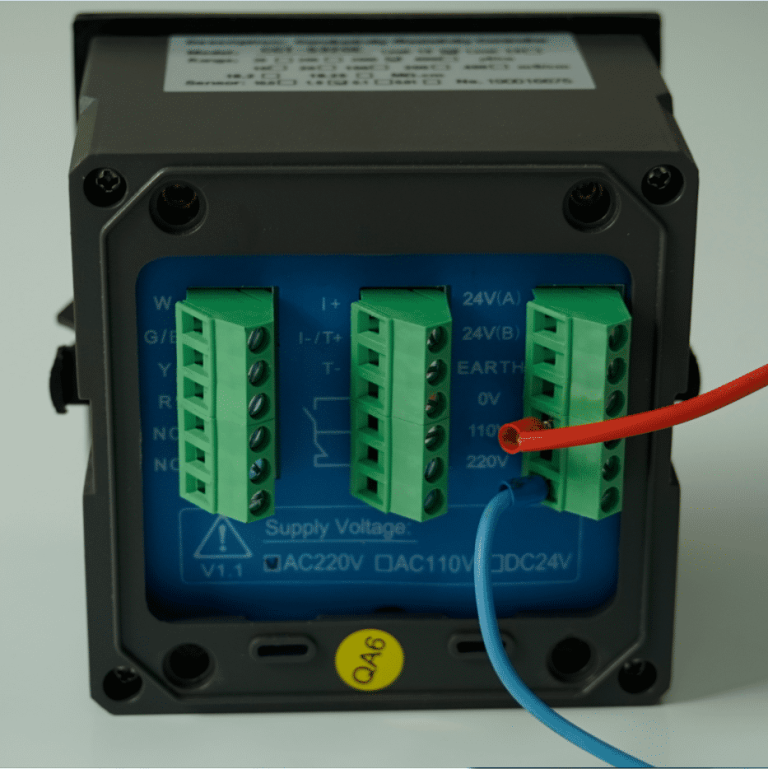
The critical enabler of continuous oxidant maintenance is real-time monitoring. Without continuous sensor feedback, operators cannot know whether the oxidant residual is actually being maintained between manual grab samples. Shanghai ChiMay’s residual chlorine transmitter provides continuous measurement of free chlorine at concentrations down to 0.01 ppm, allowing automated feed systems to maintain the target residual around the clock.
ORP monitoring complements residual chlorine measurement by capturing the overall oxidative capacity of the water. In systems where multiple oxidant sources are used—chlorine, bromine, ozone, or AOP-generated hydroxyl radicals—ORP provides a single integrated metric that reflects the total oxidative environment. Shanghai ChiMay recommends maintaining cooling tower ORP above 450 mV for effective microbiological control, with alarm setpoints at 400 mV to provide intervention lead time.
Turbidity as an Early Warning Indicator
Beyond oxidant monitoring, turbidity measurement has emerged as a valuable surrogate for biofilm sloughing events. When biofilm detaches from cooling tower surfaces—whether due to biocide action, flow changes, or thermal cycling—it creates a spike in suspended solids and turbidity. That spike often precedes a detectable increase in Legionella counts by 24–72 hours, providing a window for proactive intervention.
Shanghai ChiMay’s online turbidity tester continuously monitors cooling water clarity, with alarm thresholds set to detect turbidity increases of more than 2 NTU above baseline. When combined with ORP and residual chlorine data, turbidity trends give operators a multi-parameter view of microbiological conditions that periodic testing simply cannot provide.
What the Data Shows
Facilities that have adopted continuous monitoring for Legionella prevention report meaningful improvements. A pharmaceutical manufacturing facility in the Netherlands transitioned from weekly dip-slide testing to continuous ORP, residual chlorine, and turbidity monitoring using Shanghai ChiMay instruments. Over an 18-month period, the facility recorded zero Legionella-positive results in monthly culture tests, while reducing total biocide consumption by 35% through more precise oxidant maintenance.
A hospital complex in Southeast Asia implemented a similar monitoring approach after experiencing two Legionella alerts in a single year. The continuous monitoring system, anchored by Shanghai ChiMay sensors, detected three ORP dropout events in the first month—each caused by a failing dosing pump. Automated alarms enabled maintenance intervention within minutes, preventing the extended low-oxidant conditions that had contributed to the earlier alerts.
The Path to Compliance and Confidence
Legionella prevention in open recirculating cooling systems is evolving from a reactive, schedule-based approach to a proactive, data-driven discipline. Continuous monitoring of residual oxidant, ORP, and turbidity provides operators with the real-time visibility needed to maintain effective microbiological control, demonstrate regulatory compliance, and protect public health. Shanghai ChiMay’s sensor portfolio is designed to support this transition, offering the reliability, range, and integration capabilities that modern cooling tower water treatment programs demand.