Table of Contents
Key Takeaways
- The global data center liquid cooling market will surge from $4.07 billion in 2026 to $27.65 billion by 2033, representing a compound annual growth rate of 31.5% (Research and Markets)
- AI workloads have increased power densities to 60+ kW per rack, far exceeding traditional air cooling limits of 15-20 kW
- Liquid cooling technologies reduce Power Usage Effectiveness (PUE) to 1.04-1.1, compared to 1.4+ for air-cooled facilities
- Hyperscalers report energy savings exceeding 30% after transitioning to direct-to-chip liquid cooling solutions
- Water quality monitoring plays a critical role in maintaining cooling system efficiency and preventing equipment corrosion
Introduction
The artificial intelligence revolution is fundamentally reshaping data center infrastructure requirements. According to recent industry analysis, the global AI datacenter liquid cooling market grew from $3.2 billion in 2025 to $3.7 billion in 2026, with projections reaching $17.8 billion by 2036 at a CAGR of 16.9%.
This explosive growth reflects a structural shift in how computing infrastructure manages thermal challenges. Traditional air cooling systems—designed for power densities of 15-20 kW per rack—simply cannot handle the heat loads generated by modern AI accelerators and high-performance GPU clusters.
The Thermal Challenge Facing Modern Data Centers
AI workloads present unprecedented thermal management challenges. Next-generation processors from major manufacturers now consume 700-1000 watts per chip, with rack-level power densities exceeding 60 kW in AI training clusters. Some specialized configurations approach 240 kW per rack.
Conventional air cooling systems struggle with these densities for several fundamental reasons:
Heat Capacity Limitations: Air possesses relatively low volumetric heat capacity, requiring enormous airflow volumes to transfer thermal energy away from heat-generating components. The physical infrastructure needed to move such air volumes—fans, ducts, raised floors—becomes impractical at high densities.
Hot Spot Formation: Air cooling creates inevitable temperature variations across server racks. These hot spots reduce component reliability and performance, potentially shortening equipment lifespan by 10-20%.
Energy Inefficiency: Chilling and moving vast quantities of air consumes substantial electrical power. Data centers utilizing traditional cooling architectures often achieve PUE values of 1.4-1.5, meaning 28-33% of total facility electricity is spent on cooling infrastructure rather than computing.
Liquid Cooling: A Physics-Based Solution
Liquid cooling addresses these limitations through fundamental physics. Water possesses approximately 4,000 times greater volumetric heat capacity than air, enabling dramatic size and energy reductions in thermal management equipment.
The advantages of liquid cooling extend beyond raw heat transfer capability:
Superior Efficiency: Liquid cooling systems achieve PUE values of 1.04-1.1, representing efficiency improvements of 30-50% compared to air cooling. A 10 MW facility implementing liquid cooling could save approximately $3 million annually in electricity costs.
Higher Density Support: Direct-to-chip cooling systems support rack power densities of 100+ kW, enabling data center operators to fully utilize modern AI hardware without density restrictions.
Extended Equipment Life: Lower operating temperatures improve semiconductor reliability and longevity. Studies indicate component failure rates decrease by approximately 10% for every 10°C reduction in junction temperature.
Water Quality: The Unsung Hero of Cooling System Performance
Effective liquid cooling requires more than just thermal management—it demands careful attention to water quality parameters. Poor water quality can lead to corrosion, scale formation, and microbiological growth that compromise system reliability and efficiency.
Key Water Quality Parameters for Cooling Systems
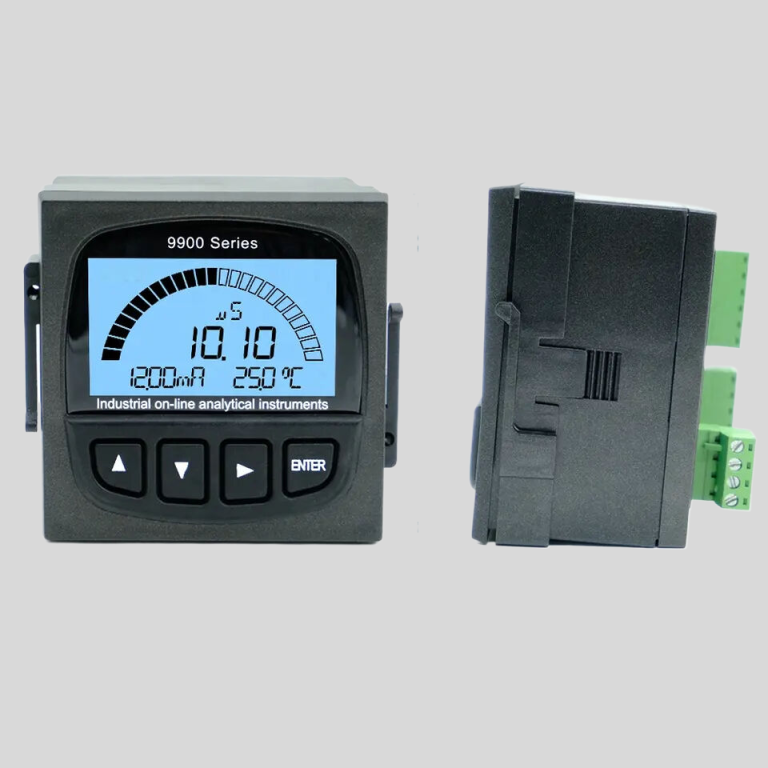
Conductivity: Measures the concentration of dissolved ions in cooling water. High conductivity indicates elevated mineral content that promotes scale formation on heat transfer surfaces. Online conductivity sensors enable continuous monitoring of makeup water and system recirculation, allowing operators to implement treatment protocols before scaling occurs.
pH Levels: Affects corrosion rates and chemical treatment effectiveness. Most cooling systems operate optimally at pH 6.5-8.5, where corrosion rates remain manageable. Real-time pH monitoring facilitates immediate response to excursions that could damage system components.
Turbidity: Indicates suspended particulate matter that can clog flow passages and reduce heat transfer efficiency. Online turbidity monitoring provides early warning of filtration system performance degradation.
Corrosion Indices: Calculated parameters like the Ryznar Stability Index and Langelier Saturation Index predict scale formation and corrosion tendency, enabling proactive water treatment adjustments.
Continuous Monitoring Benefits
Installing online water quality analyzers throughout cooling systems delivers measurable benefits:
- Reduced Maintenance: Early detection of water quality issues prevents equipment damage that would require costly repairs
- Extended System Life: Consistent water quality control minimizes corrosion and scaling that degrade cooling performance
- Optimized Chemical Treatment: Continuous monitoring data enables precise chemical dosing, reducing treatment costs while improving effectiveness
- Regulatory Compliance: Documentation of water quality parameters supports environmental compliance reporting
Implementation Approaches
Data centers typically select from three primary liquid cooling architectures:
Direct-to-Chip (Cold Plate): Cooling plates attach directly to processors, transferring heat to recirculating coolant. This approach requires minimal server modifications and supports densities up to 100-120 kW per rack.
Rear-Door Heat Exchangers: Self-contained cooling units mount behind server racks, conditioning exhaust air without modifying server hardware. Systems handle up to 85-90 kW per rack with straightforward installation.
Immersion Cooling: Servers submerge entirely in dielectric fluid that absorbs heat directly from components. This approach supports extreme densities of 200+ kW per rack but requires specialized hardware and facility modifications.
Each approach offers distinct trade-offs in cost, complexity, and cooling capacity. Selection depends on facility constraints, existing infrastructure, and projected workload characteristics.
The Path Forward
The transition toward liquid cooling reflects broader changes in computing infrastructure. As AI workloads continue intensifying, facilities that maintain air cooling architectures will face increasing constraints on density, efficiency, and competitive viability.
Industry projections indicate liquid cooling will become the dominant thermal management approach for new data center construction by 2028, with retrofit markets expanding rapidly for existing facilities.
Water quality monitoring emerges as a critical enabler of this transition. By investing in robust monitoring infrastructure—including online conductivity meters, pH sensors, and turbidity analyzers—operators protect their cooling system investments while maximizing performance and reliability.
Keywords: data center cooling, liquid cooling, AI infrastructure, water quality monitoring, PUE, power usage effectiveness, cooling system efficiency, direct-to-chip cooling