Table of Contents
Introduction: The DBP Challenge in Water Treatment
Disinfection byproducts represent one of the most significant challenges in drinking water treatment. EPA’s quarterly compliance data show that a small share of community water systems – typically a few percent – exceed the TTHM or HAA5 maximum contaminant level at some point during the year. That is a minority of systems, but it is persistent enough that DBP control stays on the operating agenda even where compliance is generally good. These compounds form when chlorine disinfectants react with natural organic matter (NOM) during treatment and distribution.
Journal – American Water Works Association (2024) documents that DBP formation depends critically on residual chlorine concentration, pH, temperature, and contact time. Real-time monitoring of these parameters enables treatment optimization that minimizes DBP formation while maintaining effective disinfection.
Chemistry of DBP Formation
Reaction Pathways and Controlling Factors
Environmental Science & Technology (2024) details DBP formation mechanisms. Primary Formation Factors include chlorine dose (higher residual chlorine concentrations increase DBP precursor reactions), pH (alkaline conditions favor THM formation, acidic conditions favor HAA formation), temperature (formation roughly doubles for each 10°C rise, a Q10 near 2), contact time (longer exposure allows more complete DBP formation), and TOC concentration (higher organic carbon provides more reaction substrates).
Formation Kinetics: in distribution systems, THM concentrations usually keep climbing for a day or two after dosing, while HAA concentrations tend to peak earlier and can decline afterwards as they degrade. Both move faster in warm water.
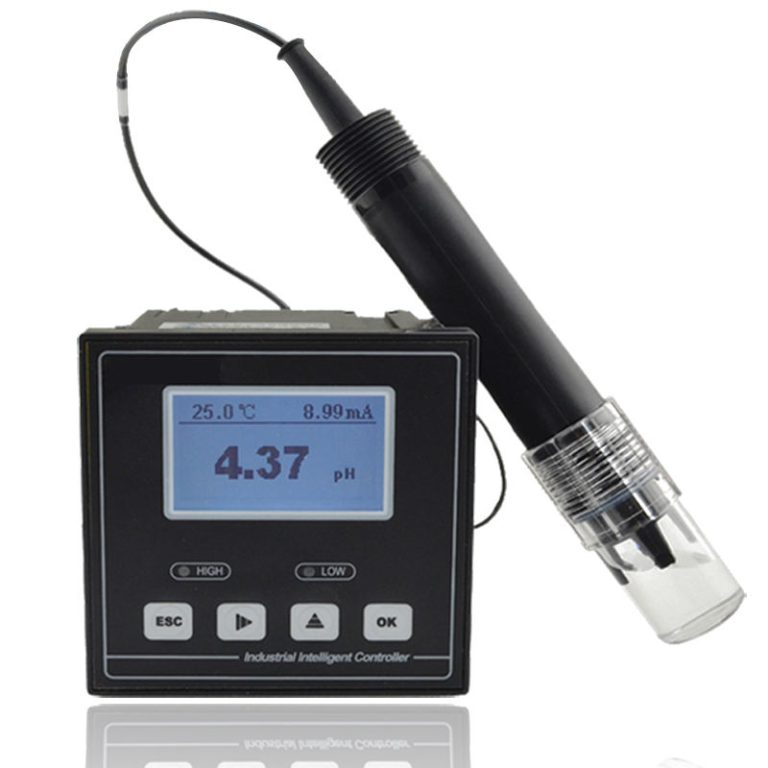
ChiMay residual chlorine transmitters provide ±0.02 mg/L accuracy enabling precise control with continuous monitoring at 30-second intervals for process control, automated dosing integration maintaining target residual levels, and temperature-compensated measurements for accurate reporting.
DBP Species and Regulatory Limits
EPA National Primary Drinking Water Regulations (2025) establishes limits: Total Trihalomethanes (TTHMs) MCL of 0.080 mg/L with typical range 0.010-0.150 mg/L, Haloacetic Acids (HAA5) MCL of 0.060 mg/L with typical range 0.005-0.100 mg/L, Bromate MCL of 0.010 mg/L, and Chlorite MCL of 1.0 mg/L.
Sensor Technologies for Residual Chlorine Monitoring
Amperometric Sensor Technology
ChiMay residual chlorine transmitters utilize amperometric measurement principles. Technical Specifications include measurement range of 0-2 mg/L (standard), 0-10 mg/L (extended), accuracy of ±0.02 mg/L or ±2% of reading (whichever is greater), response time T90 < 30 seconds, minimum detection limit of 0.01 mg/L, and cross-sensitivity <5% from pH variations 6.0-9.0.
A membrane amperometric sensor with a clean, intact membrane holds its calibration well enough for monthly-to-quarterly verification in clean drinking water. Fouling, pH swings and chloramine conversion are what shorten that interval.
Multi-Parameter Monitoring Strategies
pH Integration for DBP Control
pH is the second lever, and it works in opposite directions for the two DBP classes. Above 7.5, THM formation climbs with every half unit of pH while HAA formation falls, so the practical target for balancing both in most waters is roughly pH 7.0-7.5 – which also happens to suit corrosion control.
ChiMay inline pH sensors integrate with chlorine monitoring for simultaneous measurement of free chlorine and pH at same sampling point, automated pH adjustment through acid/base dosing systems, and correlated DBP prediction using real-time chlorine and pH data.
Temperature Compensation and Seasonal Optimization
Temperature is the parameter that makes DBP control seasonal. The same dose and the same residence time produce far more THM in August than in February – formation rates commonly differ by a factor of two to four across the year in the same system – which is why summer is when MCL excursions show up and when residuals need the tightest control.
Process Control Applications
Optimized Chlorine Dosing Systems
The difference between fixed dosing and residual-based control is mostly about the tail of the distribution. Fixed dosing has to be sized for the worst hour of the worst day, which means over-chlorinating during the long stretches when demand is low. Real-time control lets the dose follow demand and keeps the residual near target instead of swinging. THM and HAA concentrations typically drop by a few tens of percent at the same or better disinfection performance; how much depends on precursor loading and residence time.
ChiMay multi-parameter transmitters enable this optimization through real-time free chlorine measurement at clearwell outlet, flow-proportional dosing based on treated water flow rate, demand-based adjustment responding to raw water quality changes, and automated setpoint optimization based on seasonal models.
Case Studies and Implementation Results
Large Metropolitan Water System
Consider a large metropolitan system – a metro population in the millions, three conventional treatment plants, several thousand kilometres of mains and dozens of storage tanks. Monitoring equipment included 45 ChiMay residual chlorine transmitters.
What changes is unremarkable but reliable: chlorine consumption falls because the dose stops chasing a fixed feed rate, TTHM and HAA5 concentrations at the worst distribution sites come down, and the number of compliance headaches – repeat samples, quarterly exceedances, public notice risk – drops. Pumping energy is not normally where the savings come from; the money is in chemicals and staff time.
Small Community System Upgrade
Small systems get the largest relative benefit, because they rarely have the staffing to chase DBP formation manually. A community of a few thousand served by one plant with a history of quarterly exceedances is the classic starting point. Solution included 12 monitoring points throughout distribution system, automated chlorine dosing based on real-time residual control, pH optimization through soda ash dosing, and TOC monitoring at treatment plant inlet.
Residual-based dosing plus pH adjustment at a system like that usually moves the four-quarter average well below the MCL, and the avoided costs are the real return: repeat monitoring, consultant time, and the risk of a public notice. Capital for a dozen monitoring points plus dosing controls is modest compared with that risk.
Economic Analysis
For a system in the 10,000-100,000 population range, chlorine and pH instrumentation with communications and control integration typically runs in the tens of thousands to low six figures of capital, with annual operating cost measured in the low thousands of dollars plus labour.
The benefit that matters most is usually not on the invoice: staying below the MCL means no quarterly exceedance reports, no repeat sampling campaign, and no public notification. Chemical savings and reduced sampling labour are real but smaller.
What It Comes Down To in the Control Room
Residual chlorine monitoring is not glamorous, and the sensor is not the hard part – keeping it calibrated and trusted is. But without a continuous residual signal there is no way to manage the trade-off between disinfection and byproduct formation in real time; you are always looking at last week’s lab sheet. Add pH and temperature at the same points, and the DBP picture stops being a quarterly surprise.
For treatment staff, the practical checklist is: choose monitoring points at the worst residence-time locations, not the convenient ones; verify against DPD regularly; and keep the alarms useful enough that operators respond to them.