Table of Contents
Introduction: Municipal WWTPs and Emerging Contaminants
Municipal wastewater treatment plants (WWTPs) serve as critical barriers against emerging contaminant release to the environment. EPA counts more than 16,000 publicly owned treatment works (POTWs) in the United States treating over 30 billion gallons of municipal wastewater per day. Secondary treatment removes a large share of many emerging contaminants – pharmaceuticals, personal care products, industrial chemicals – but the removal rate depends heavily on the compound, the solids retention time, and the water temperature. However, removal efficiency varies dramatically based on treatment technology, operational practices, and influent characteristics.
Plants that add a polishing step – ozonation, UV/H2O2, or granular activated carbon after tertiary filtration – routinely push removal of many compounds above 90% in full-scale operation. The stubborn ones are polar and poorly biodegradable: certain X-ray contrast media, some anticonvulsants, and a few industrial additives. Multi-parameter sensor networks provide the real-time data necessary for optimizing these treatment processes.
Emerging Contaminant Removal Mechanisms
Biological Treatment Performance
Four removal pathways matter in biological treatment: biodegradation (microbial degradation of biodegradable compounds), adsorption (attachment to biomass for hydrophobic compounds), stripping (volatilization for semi-volatile compounds), and photolysis (UV degradation in surface water receiving waters).
Typical removal ranges reported by stage (individual results vary with SRT, temperature and influent mix):
| Treatment Stage | Pharmaceutical Removal (%) | PPCP Removal (%) | Pesticide Removal (%) |
|---|---|---|---|
| Primary clarification | 10-30% | 15-40% | 5-25% |
| Conventional activated sludge | 40-70% | 50-80% | 30-60% |
| Extended aeration | 60-85% | 70-90% | 50-75% |
| Membrane bioreactor (MBR) | 80-95% | 85-97% | 70-90% |
| Tertiary filtration | 85-98% | 90-99% | 80-95% |
| Advanced oxidation (O₃/UV) | 90-99% | 92-99% | 85-98% |
Critical Process Parameters
Key process parameters: biological treatment needs dissolved oxygen (DO) of 2-4 mg/L for aerobic degradation, SRT (Sludge Retention Time) of >10 days for pharmaceutical removal, temperature of 15-25°C for optimal microbial activity, and pH of 6.5-8.0 for most biological processes.
advanced treatment typically uses an ozone dose of 5-15 mg/L for oxidation, UV dose of 400-1,000 mJ/cm² for photolysis, hydrogen peroxide of 2-10 mg/L for advanced oxidation, and contact time optimized based on compound-specific requirements.
Multi-Parameter Sensor Technologies
4-in-1 Multi-Parameter Sensors
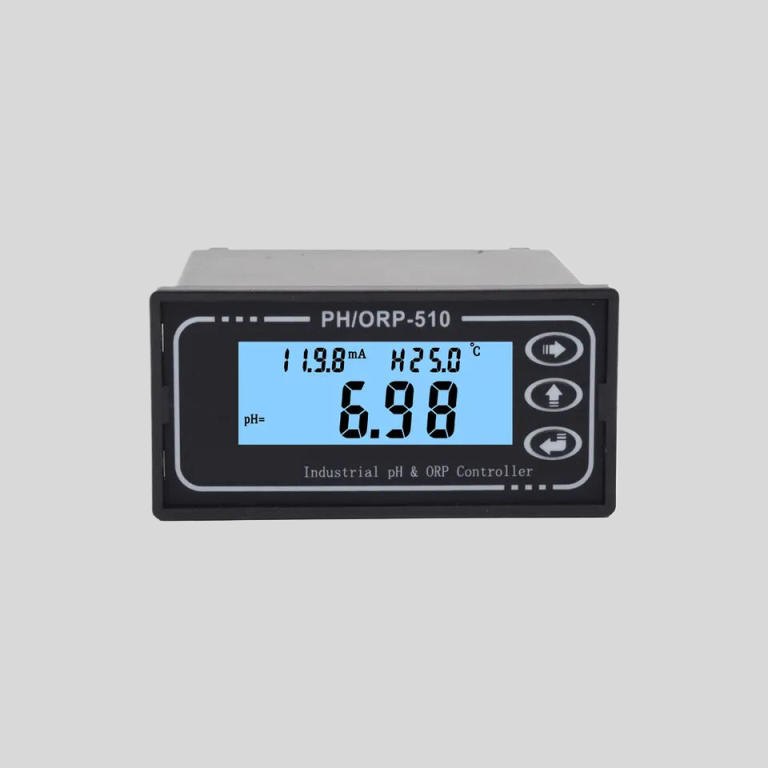
ChiMay 4-in-1 multi-parameter sensors integrate multiple measurements. Typical Configuration includes pH sensor with ±0.02 accuracy and 0-14 range, dissolved oxygen sensor with ±0.1 mg/L accuracy and 0-20 mg/L range, conductivity sensor with ±0.5% accuracy and 0-200 mS/cm range, and ORP sensor with ±5 mV accuracy and ±1,000 mV range.
Integration Benefits include single installation point reducing mounting complexity, unified data acquisition with synchronized measurements, simplified calibration with one procedure for multiple parameters, and cost advantage of 30-40% savings compared to individual sensors.
A multi-parameter probe is not inherently less accurate than separate single-parameter instruments, but every channel still has to be calibrated and verified on its own schedule.
Sensor Network Architecture
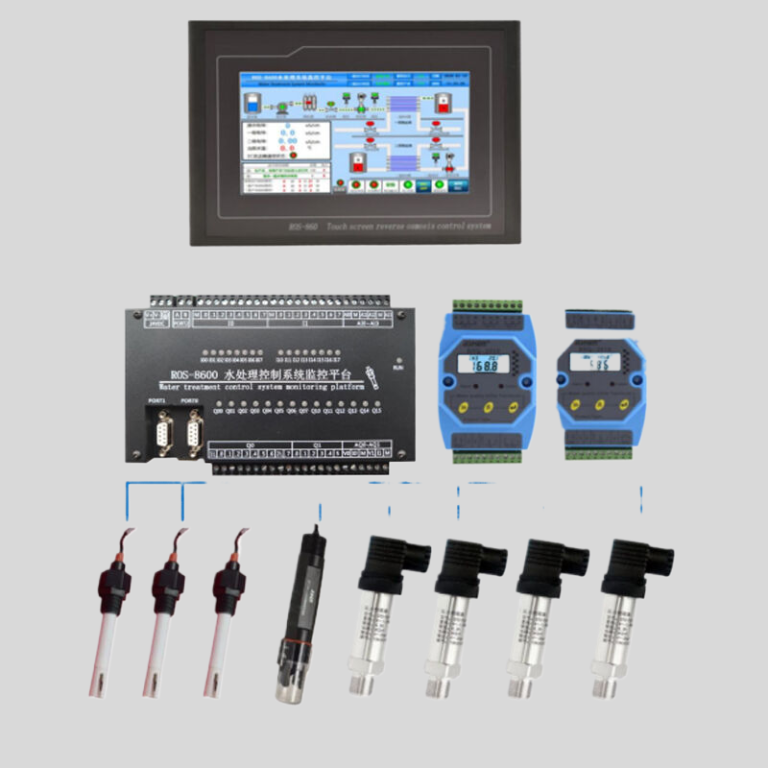
SCADA Integration Guidelines with recommended network configuration:
| Parameter | Primary Location | Secondary Location | Critical Threshold |
|---|---|---|---|
| pH | Biological reactor | Secondary clarifier | <6.5 or >8.5 |
| DO | Aeration basin (multiple zones) | Secondary clarifier | <1.5 mg/L |
| Conductivity | Influent | Effluent | >2,000 μS/cm |
| Turbidity | Secondary effluent | Membrane feed | >10 NTU |
| Temperature | Biological reactor | Influent | <10°C or >35°C |
Communication Options include Modbus RTU/TCP for standard industrial communication, 4-20 mA analog for direct PLC integration, Wireless (LoRaWAN) for remote installation without wiring, and OPC-UA for modern industrial IoT integration.
Process Control Applications
Aeration Basin Optimization
In practice, aeration control logic looks like this: Zone-Based DO Control increases zone1 aeration when zone1_DO <2.0 mg/L AND zone1_NH3 >1.0 mg/L, and reduces zone3 aeration to balance.
Plants moving from fixed aeration to zone-based DO control typically cut aeration energy by roughly 20-35% and get steadier ammonia removal as a side effect, with lower SVI when the DO profile is kept away from the extremes.
Time-Based Aeration Adjustment includes peak load periods increasing aeration during high flow, low load periods reducing aeration to save energy, and diurnal patterns adjusting based on daily load variations.
Nutrient Removal Optimization
Nitrogen Removal Control with nitrification-denitrification balance using ammonia sensor to monitor nitrification progress, nitrate sensor to verify denitrification completion, ORP sensor to identify denitrification endpoint, and pH sensor to detect biological activity changes.
Carbon Addition Control uses COD/BOD monitoring to determine external carbon requirement, online COD sensors for real-time methanol/acetate dosing optimization, and external carbon dosing usually falls by a third or more once feedback control replaces fixed dosing.
Case Studies
Full-Scale MBR Facility Optimization
Take a 25,000 m³/day membrane bioreactor with sidestream ozonation. The monitoring is dense: multi-parameter probes through the treatment train instead of a single analyzer at the outlet.
What that instrumentation buys is the ability to see the train as a chain of causes instead of a black box. Measured COD tracks the organic load that drives trace-organic removal, DO control keeps the biology where it belongs instead of leaving the blowers wide open, and turbidity at the membrane feed is what actually protects the membranes. Plants that make that shift report lower aeration energy at the same removal performance, longer membrane life and fewer chemical-related upsets. The direction of the change is consistent; the percentages are site-specific.
Conventional Activated Sludge Upgrade
The more common project is a retrofit: a conventional activated sludge plant serving around 50,000 PE with inconsistent trace-organic removal, where the goal is better removal without pouring new concrete.
Sensor-based optimization in that situation means a handful of probes across the aeration basin, zone DO control driven by those readings, a longer sludge age set from the ammonia trend rather than from habit, and RAS control based on clarifier turbidity.
Results in this pattern are predictable in direction: trace-organic removal improves substantially, aeration energy rises slightly because of the longer sludge age, sludge production increases, and the net operating position improves.
Economic Analysis
For a plant in that size class, a full sensor network with installation and SCADA integration typically lands in the low-to-mid six figures of capital cost, with annual operating cost in the tens of thousands of dollars.
Benefits spread across energy, chemicals, sludge handling, equipment life and – hardest to monetize but often the largest – the ability to demonstrate compliance with continuous data instead of a filing cabinet of handwritten log sheets. Payback is usually measured in a couple of years at energy-heavy plants and longer at small, low-energy ones.
Where Instrumentation Actually Pays Off
Multi-parameter networks are the data layer everything else sits on: without continuous measurement you cannot tell whether a process change is helping or hurting. With it, operators can hold removal performance closer to what the plant is capable of, shave energy and chemical cost, and document performance continuously instead of sampling their way to a compliance report.
For plant engineers the practical question is not whether to instrument, but where to start: the aeration basin DO profile and the final effluent are usually where the first sensors earn their keep.