The short version:
– These six parameters cover the compliance and process decisions that mining water management turns on
– Continuous monitoring mainly buys fewer surprises, which is worth more than any single cost saving
– The International Council on Mining and Metals publishes water reporting guidance that most large miners align their metrics with, though the parameter list itself comes from permits and site conditions
– Instrument choice matters less than calibration discipline at most mine sites
Effective water quality management at a mine means monitoring several parameters at once, because they interact: pH drives metal solubility, turbidity and TSS track each other, and temperature changes the behaviour of everything else. This guide covers the six that carry the most weight in permits and in process control.
This guide examines each critical parameter, explaining why it matters and how modern instrumentation enables reliable continuous monitoring.
Table of Contents
1. pH: The Foundation of Water Chemistry
pH measures hydrogen ion concentration on a logarithmic scale from 0 to 14, with 7 representing neutral conditions. In mining applications, pH drives chemical reactions affecting both process efficiency and environmental compliance.
Why pH Matters in Mining
Mining processes generate both acidic and alkaline effluents requiring precise pH control:
- Heap leaching: Gold extraction requires pH 9.5-11.0 for cyanide stability, while copper leaching needs pH 1.5-2.5 for optimal acid consumption
- Tailings management: pH influences metal solubility and precipitation behavior
- Effluent compliance: Most discharge permits specify pH ranges of 6.0-9.0
Monitoring Approach
In-line pH electrodes provide continuous measurement for process control, while handheld meters support field verification and calibration checks. The U.S. EPA lists Method 150.1 for electrometric pH measurement, and mining-grade instruments are normally specified at ±0.1 pH unit or better.
Shanghai ChiMay’s mining-grade pH sensors feature double junction reference systems, which resist the sulfide poisoning that kills ordinary reference electrodes in mining water. How long a probe holds calibration depends on the application: high-sulfide or high-solids streams need more frequent attention than clean process water.
2. Conductivity: Measuring Ionic Content
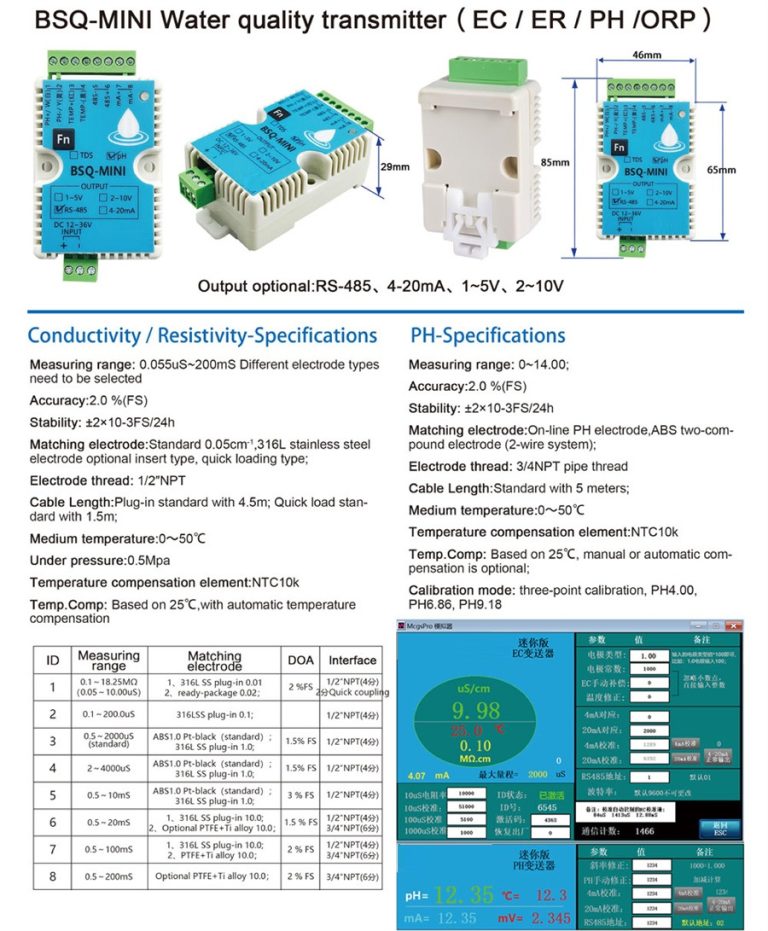
Conductivity measures water’s ability to conduct electrical current, directly proportional to dissolved ion concentration. Units typically expressed as μS/cm (microsiemens per centimeter) or mS/cm (millisiemens per centimeter).
Applications in Mining
Conductivity serves multiple monitoring objectives:
- Water classification: Distinguishes fresh water (<1,500 μS/cm), brackish water (1,500-15,000 μS/cm), and saline water (>15,000 μS/cm)
- Concentration measurement: Determines acid and reagent concentrations in process streams
- Dissolved solids estimation: Total dissolved solids (TDS) approximately equals conductivity multiplied by 0.55-0.75 depending on ionic composition
- Leachate detection: Identifies groundwater contamination from process areas
Instrumentation
In-line conductivity meters with appropriate cell constants measure across the full range of mining applications. Standard practice is to reference conductivity readings to 25°C with automatic temperature compensation, so that two readings actually compare the same thing.
Shanghai ChiMay offers conductivity sensors with cell constants ranging from 0.01 to 10.0 cm⁻¹, enabling accurate measurement from ultra-pure water to concentrated brines.
3. Turbidity: Quantifying Suspended Particles
Turbidity measures light scattering by suspended particles, expressed in NTU (Nephelometric Turbidity Units). This parameter serves as both a compliance metric and process indicator.
Regulatory Significance
Major mining jurisdictions establish turbidity limits:
- U.S. EPA: NPDES permits set turbidity limits case by case, often in the tens of NTU; the permit text is the only number that counts
- Australia: the ANZECC/ANZG water quality guidelines give turbidity trigger values in the low NTU range for slightly disturbed ecosystems
- Canada: the Metal and Diamond Mining Effluent Regulations regulate total suspended solids (15 mg/L monthly mean, 25 mg/L maximum grab) rather than turbidity
Treatment Optimization
Turbidity monitoring optimizes water treatment processes:
- Coagulant dosing: Turbidity response indicates optimal chemical addition rates
- Filter performance: Headloss and turbidity breakthrough trigger backwash cycles
- Thickener control: Overflow turbidity optimizes underflow solids concentration
Online turbidity sensors employing nephelometric principles provide continuous measurement per USEPA Method 180.1 or ISO 7027.
4. Dissolved Oxygen: Critical for Biological Processes
Dissolved oxygen (DO) measures oxygen concentration dissolved in water, expressed as mg/L or % saturation. DO concentrations control oxidation-reduction reactions affecting water chemistry.
Mining Applications
DO monitoring serves multiple purposes:
- Acid mine drainage: DO levels control iron oxidation rates, affecting treatment requirements
- Tailings storage: Low DO in water columns may indicate biological oxygen demand
- Receiving water: DO depression downstream of discharges impacts aquatic life
- Process optimization: DO measurements optimize aeration in treatment systems
Measurement Technology
Membrane-covered DO electrodes provide continuous measurement with response times of 60-90 seconds. The American Society for Testing and Materials (ASTM) D888 covers the polarographic and Winkler-based reference test methods that online sensors are checked against.
Shanghai ChiMay’s dissolved oxygen transmitters achieve accuracy of ±0.2 mg/L with automatic temperature compensation across ranges of 0-20 mg/L.
5. Total Suspended Solids (TSS): Mass-Based Solids Measurement
While turbidity indicates optical properties, TSS measures actual mass of suspended particles per unit volume (mg/L). Direct TSS measurement provides regulatory compliance data where required.
Regulatory Requirements
Discharge permits often specify TSS limits:
- U.S. EPA: effluent guideline limits for TSS sit in the tens of mg/L for most mining categories; the permit value is what applies
- EU Mining Waste Directive: Requirements vary by mine type and discharge location
Monitoring Relationship
Turbidity and TSS correlate, enabling estimation:
- Typical ratio of 1.2:1 to 2.0:1 NTU to mg/L depending on particle characteristics
- Site-specific calibration required for accurate estimation
- Regular gravimetric verification recommended
Suspended solids sensors using optical or acoustic principles provide continuous measurement, with ISO 11923 specifying gravimetric reference methods.
6. Temperature: Affecting All Water Quality Parameters
Temperature influences water chemistry through temperature-dependent reaction rates, gas solubility, and biological activity. All water quality sensors require temperature compensation for accurate results.
Mining Significance
Temperature monitoring addresses multiple concerns:
- Process control: Temperature affects leaching kinetics and reagent consumption
- Discharge compliance: Thermal plumes may require monitoring
- Sensor accuracy: All sensor measurements require temperature compensation
- Ecological impact: Thermal stress affects aquatic organisms
Measurement Integration
Modern multi-parameter sensors integrate temperature measurement with primary parameters, providing automatic compensation. Standalone temperature sensors using RTD (Resistance Temperature Detector) technology achieve accuracy of ±0.1°C.
Implementing Comprehensive Monitoring
Effective monitoring programs integrate all six parameters through modern instrumentation and data management systems.
Technology Integration
Multi-parameter sensor systems combine multiple measurements in single installations:
- Reduces installation complexity and maintenance burden
- Enables cross-parameter data analysis
- Supports comprehensive facility dashboards
Shanghai ChiMay’s 4-in-1 multi-parameter sensors integrate pH, conductivity, turbidity, and temperature measurement with digital communication outputs for SCADA integration.
Data Management
Cloud-based monitoring platforms aggregate data from multiple sensors and locations:
- Automated regulatory reporting
- Trend analysis and anomaly detection
- Alert notification and escalation
- Historical data storage and retrieval
Calibration Requirements
Regular calibration maintains measurement accuracy:
| Parameter | Calibration Frequency | Standard/Reference |
|---|---|---|
| pH | Weekly to monthly | NIST buffer solutions |
| Conductivity | Monthly | KCl reference solutions |
| Turbidity | Monthly | Formazin standards |
| Dissolved Oxygen | Weekly | Winkler titration or air calibration |
| TSS | Per regulatory schedule | Gravimetric analysis |
| Temperature | Annual | NIST-traceable reference |
Cost-Benefit Analysis
Investment in comprehensive monitoring delivers measurable returns:
Avoided Compliance Costs
Continuous monitoring prevents exceedances that trigger penalties:
- Penalty avoidance: exceedances caught before they become reportable violations
- Reduced sampling costs: laboratory work shifts from routine rounds to exception samples
- Expedited permitting: a good monitoring record supports permit negotiation and renewal
Operational Efficiency
Monitoring data optimizes treatment processes:
- Chemical savings: dosing that follows actual load rather than a fixed rate
- Energy savings: pumping and aeration that follow demand
- Equipment protection: Early detection prevents damage to downstream equipment
The savings that matter are site-specific. A mine with a difficult discharge and a small operations team will see a clearer return than one with generous dilution and plenty of staff.
Wrapping up
Comprehensive water quality monitoring forms the foundation of responsible mining water management. The six parameters examined in this guide—pH, conductivity, turbidity, dissolved oxygen, TSS, and temperature—provide the information necessary for regulatory compliance, process optimization, and environmental protection.
Modern instrumentation including in-line pH electrodes, conductivity meters, turbidity sensors, and multi-parameter systems enables reliable continuous monitoring that transforms water management from reactive compliance to proactive optimization.
Shanghai ChiMay’s complete product portfolio addresses each critical parameter, with integrated solutions designed specifically for the demanding conditions of mining applications.