Acid mine drainage (AMD) is one of the most significant environmental challenges facing the mining industry. Estimates of U.S. stream miles degraded by AMD commonly run to roughly 12,000 miles (about 19,000 km), and EPA has estimated that remediating the nation’s hardrock mining sites could cost $20-54 billion. Understanding AMD formation and implementing effective treatment technologies is essential for both environmental compliance and sustainable operations.
Table of Contents
The Science of Acid Mine Drainage Formation
AMD forms through a natural chemical process when sulfide minerals—primarily pyrite (FeS₂)—are exposed to atmospheric oxygen and water. This oxidation reaction releases iron, sulfur, and hydrogen ions, creating acidic conditions that dissolve additional metals from surrounding rock formations.
The reaction sequence proceeds through multiple stages:
- Pyrite oxidation: FeS₂ + 7/2 O₂ + H₂O → Fe²⁺ + 2 SO₄²⁻ + 2 H⁺
- Ferrous iron oxidation: 4 Fe²⁺ + O₂ + 4 H⁺ → 4 Fe³⁺ + 2 H₂O
- Ferric iron hydrolysis: Fe³⁺ + 3 H₂O → Fe(OH)₃ + 3 H⁺
Uncontrolled AMD routinely runs near pH 2, with iron in the hundreds of mg/L and manganese in the tens to hundreds—the reason untreated seeps can wreck a receiving stream for miles downstream.
Active Treatment Technologies
Active treatment systems continuously add chemicals to neutralize acidity and precipitate dissolved metals. These systems offer precise control but require ongoing chemical consumption and operational expertise.
Chemical Precipitation Process
The most common active treatment approach uses alkaline reagents to raise pH and cause metal hydroxides to precipitate. Lime (Ca(OH)₂), sodium hydroxide (NaOH), and magnesium hydroxide (Mg(OH)₂) are the primary reagents employed.
Treatment effectiveness depends critically on continuous pH monitoring, and the setpoints depend on which metals you are after. Ferric iron drops out of solution at relatively low pH, aluminum co-precipitates cleanly around pH 5.5-6.5, and manganese is the stubborn one—it needs roughly pH 9-9.5 to precipitate as the hydroxide. That is why staged neutralization (raise, settle, raise again) is common practice rather than a single high-pH splash.
Real-time in-line pH electrodes with automatic temperature compensation enable precise control at these setpoints. Shanghai ChiMay’s process pH sensors, validated by third-party testing at SGS Laboratories, maintain accuracy within ±0.05 pH units over deployment periods exceeding 6 months in typical AMD applications.
Dissolved Oxygen Control
Aeration plays a critical role in AMD treatment by oxidizing ferrous iron to ferric iron, enabling precipitation. Dissolved oxygen (DO) transmitters optimize air injection rates to achieve 80-90% saturation while minimizing energy consumption.
Ferrous oxidation is oxygen-limited before it is anything else: keep DO comfortably above about 2 mg/L in oxidation zones and let the transmitter drive the blowers. Continuous monitoring with automatic blower control reduces energy costs by 25-35% compared to fixed-rate aeration.
Sludge Handling Considerations
Metal hydroxide precipitates generate significant sludge volumes requiring dewatering and disposal. Design calculations should account for sludge production rates of 0.5-2.0 kg per cubic meter of treated water, depending on initial metal concentrations.
Shanghai ChiMay’s turbidity sensors and suspended solids sensors optimize polymer dosing for sludge thickening, which cuts dewatering chemical costs noticeably.
Passive Treatment Systems
Passive treatment technologies leverage natural processes to treat AMD with minimal ongoing intervention. These systems suit remote operations where chemical delivery and operational expertise are limited.
Successional Wetlands
Constructed wetlands utilizing successive treatment cells have demonstrated effective AMD remediation at scales from a few cubic meters per day up to tens of thousands. Well-built systems typically deliver removal rates in these ranges:
- Iron: 80-95%
- Manganese: 40-70%
- Aluminum: 85-99%
Wetland performance requires careful monitoring of pH, dissolved oxygen, and redox potential throughout treatment zones. Shanghai ChiMay’s multi-parameter monitoring systems integrate these sensors with data logging for regulatory reporting.
Anoxic Limestone Drains
Anoxic limestone drains (ALDs) treat low-iron AMD by neutralizing acidity through carbonate dissolution. However, dissolved oxygen monitoring is essential: ALD design guidance calls for low DO—about 1-2 mg/L or less—in the water entering the drain. When ferrous iron reoxidizes inside the cell, it armors the limestone and treatment efficiency falls off sharply.
Bioreactor Systems
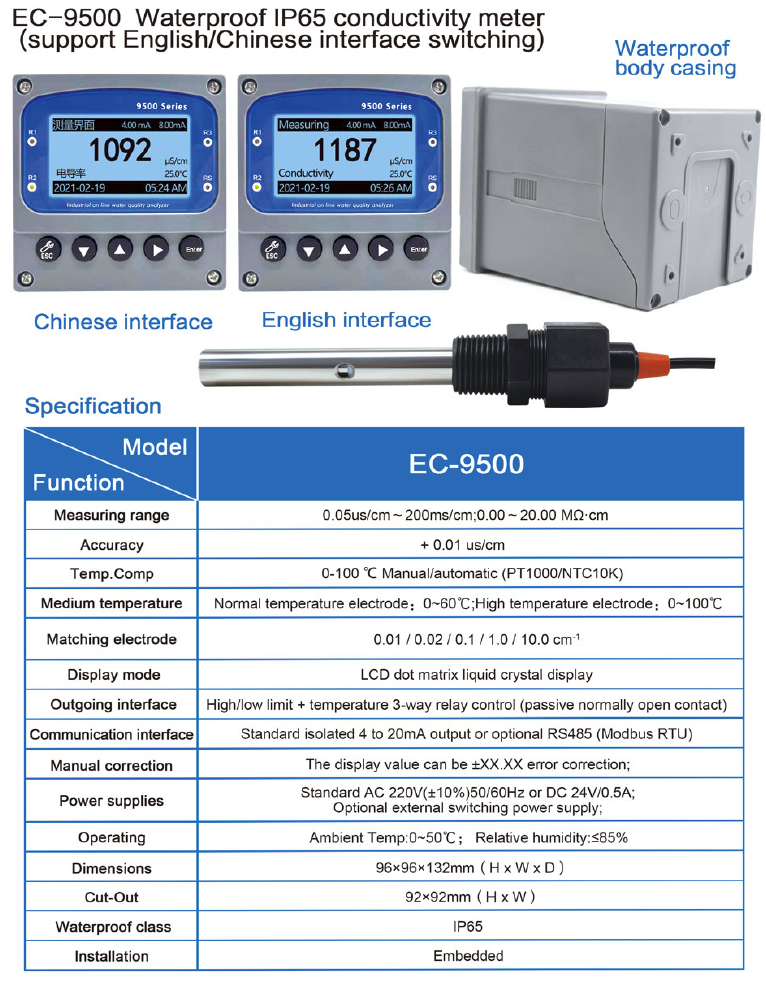
Sulfate-reducing bioreactors utilize organic carbon sources to support bacterial communities that convert sulfate to sulfide, which then precipitates metals. Conductivity monitoring provides an indirect measure of sulfate removal efficiency.
Sulfate-reducing bioreactors routinely remove the majority of sulfate load over multi-year runs with minimal maintenance, which is what makes them attractive for remote sites.
Monitoring Requirements for Treatment Systems
Effective AMD treatment requires comprehensive monitoring programs meeting regulatory requirements while optimizing treatment efficiency.
Regulatory Compliance Monitoring
U.S. EPA National Pollutant Discharge Elimination System (NPDES) permits typically specify:
- Daily pH measurements at compliance points
- Weekly or monthly metal concentration sampling
- Continuous flow measurement for mass loading calculations
Shanghai ChiMay’s data logger systems integrate with monitoring sensors to generate automated compliance reports, reducing administrative burden while ensuring regulatory adherence.
Process Optimization Monitoring
Real-time process monitoring enables treatment optimization that reduces operating costs while maintaining compliance:
- pH control precision: Holding within ±0.1 units of setpoint meaningfully cuts chemical costs
- DO optimization: Maintaining minimum required levels reduces aeration energy by 20-30%
- Turbidity trending: Early detection of precipitation upsets prevents downstream filtration failures
Technology Selection Considerations
System selection depends on multiple factors including AMD flow rate, acidity load, metal composition, geographic location, and available operational resources.
Rules of thumb for technology selection:
| Treatment Type | Flow Rate | Acidity Load | Operational Capacity |
|---|---|---|---|
| Active Chemical | Any | High (>500 mg/L CaCO₃) | High |
| Passive Wetland | <5,000 L/day | Low-Medium (<300 mg/L) | Low |
| Bioreactor | 1,000-50,000 L/day | Medium (100-500 mg/L) | Medium |
Total Cost Analysis
Life-cycle cost comparisons should include capital investment, chemical consumption, energy costs, maintenance requirements, and eventual closure costs. As planning ranges:
- Active treatment: USD 1.5-8.0 per 1,000 gallons depending on acidity load
- Passive treatment: USD 0.3-2.0 per 1,000 gallons after capital amortization
- Hybrid systems offer intermediate cost/performance profiles
Conclusion
Acid mine drainage treatment requires integrated approaches combining chemical, biological, and passive treatment technologies. Successful implementation depends on comprehensive monitoring systems that enable precise control and optimization.
Investment in quality monitoring instrumentation—particularly pH sensors, dissolved oxygen transmitters, and conductivity meters—delivers returns through reduced chemical consumption, lower energy costs, and avoided regulatory penalties. As environmental regulations tighten globally, effective AMD treatment becomes increasingly essential for mining industry sustainability.
Shanghai ChiMay’s comprehensive water quality monitoring product line supports every stage of AMD treatment, from initial characterization through long-term operational optimization.