Corrosion is one of the oldest cost problems in chemical processing, and water-side corrosion is a large part of it. Dissolved oxygen, chlorides, acids and pH swings in process water create conditions that can take a carbon steel line or a heat exchanger tube out of service far sooner than the design life suggests. What has changed in the last two decades is the instrumentation: online conductivity, pH, dissolved oxygen and ORP measurement now give a plant continuous visibility into the water chemistry that drives corrosion.
This article covers the mechanisms worth monitoring in chemical process water, the sensor set that covers them, and how to place and use the instruments.
Table of Contents
Understanding Corrosion Mechanisms in Chemical Process Water
Electrochemical Corrosion Fundamentals
Corrosion in chemical process water systems occurs mainly through electrochemical mechanisms, with simultaneous anodic and cathodic reactions at the metal-water interface. When metal surfaces contact aggressive water chemistry, galvanic cells form and drive metal dissolution — the standard treatment of this is covered in the corrosion textbooks and in ASM International’s corrosion references.
The anodic reaction releases metal ions:
Fe → Fe²⁺ + 2e⁻ (anodic reaction)
The rate depends on dissolved oxygen, chloride content, temperature and pH. Chloride is the parameter most often implicated in localised attack on stainless steels, since it breaks down passive films and promotes pitting; the severity depends strongly on concentration, temperature and alloy, so the effect should be evaluated for the specific metallurgy rather than assumed.
The cathodic reaction in aerated water typically involves oxygen reduction:
O₂ + 2H₂O + 4e⁻ → 4OH⁻
The combination of these reactions produces iron hydroxide deposits that can either protect the surface or, where they form unevenly, create the oxygen-concentration cells that drive under-deposit corrosion.
Key Corrosion Accelerators in Chemical Process Water
| Corrosion Factor | Impact Level | Detection Method |
|---|---|---|
| Dissolved Oxygen | Critical in aerated systems | DO Transmitter |
| Chloride Ion | High for stainless steels | Conductivity / chloride analysis |
| Low pH | Critical in acid service | pH Electrode |
| High Temperature | High (kinetics) | Temperature Sensor |
| Scaling Precursors | Moderate | Turbidity / hardness monitoring |
| Hydrogen Sulfide | Critical in sour service | ORP Sensor |
Temperature Effects: As a rule of thumb, corrosion rates roughly double for every 10°C increase in water temperature, up to the point where dissolved oxygen becomes limiting (typically above 60°C). This is an Arrhenius-type relationship and it holds well enough for trending and for setting alarm thresholds.
Flow Velocity Impact: Turbulent flow at velocities above roughly 1.5 m/s can physically remove protective scale layers and promote under-deposit corrosion in some geometries. At the other end, stagnant conditions below roughly 0.3 m/s allow settling of suspended solids and biological growth. Both extremes are design issues; the monitoring value is in knowing which side of the envelope you are on.
Advanced Monitoring Technologies
Online Conductivity Sensors
Online conductivity sensors are the backbone of a corrosion monitoring program in process water. They measure the water’s ability to carry current, which tracks dissolved ion concentration closely and therefore acts as a fast indicator of process upsets, leaks between heat exchanger sides, and changes in cycles of concentration:
Early Warning Capability: Sudden conductivity changes usually indicate contamination or a process upset, both of which can accelerate corrosion. What conductivity does well is detect change quickly; what it cannot do is tell you which species changed, which is why it is used alongside specific ion measurement where the chemistry matters.
Scaling and Corrosion Differentiation: By monitoring conductivity trends alongside pH, ORP and temperature, operators can distinguish between scaling conditions and active corrosion. Shanghai ChiMay’s conductivity sensors include temperature compensation and hold measurement accuracy within ±0.5% across the typical process water range of 5-95°C.
Concentration Cycle Control: In recirculating cooling systems, conductivity measurement drives blowdown control, which is the main lever on both scaling and corrosive ion concentration.
pH Monitoring Systems
Maintaining pH in the right band is one of the most effective corrosion control measures. The relationship is well established:
- pH 6.5-7.5: Minimum corrosion rate zone for carbon steel in most waters
- pH <6.0: Accelerating acid attack begins
- pH >9.0: Caustic cracking risk in certain alloys, and a scaling risk in hard waters
The bands are indicative — the correct range depends on the metallurgy, the water chemistry and the corrosion inhibitor program.
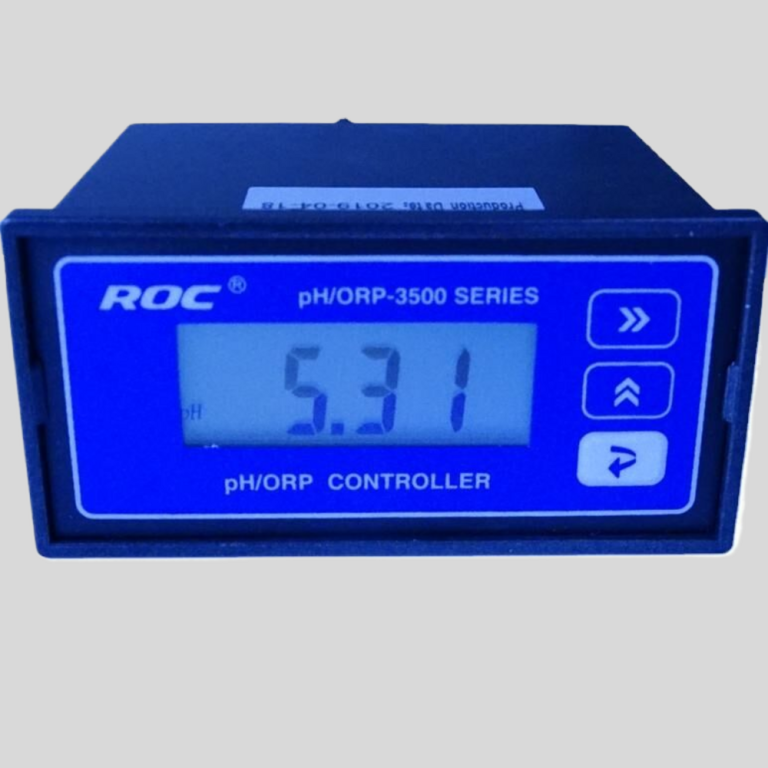
Digital pH sensors from Shanghai ChiMay use glass electrode technology with reference junction protection for chemically aggressive service. The instruments hold measurement stability of ±0.02 pH over 30-day calibration intervals, and optional reference junction designs extend service life in high-contamination applications.
Dissolved Oxygen Monitoring
Dissolved oxygen is the primary cathodic reactant in aerated water corrosion, so continuous DO measurement is the basis for assessing corrosion potential:
| DO Level | Corrosion Character | Typical Response |
|---|---|---|
| < 0.5 ppm | Low oxygen activity | Monitor for localised cells |
| 0.5-2.0 ppm | Moderate | Acceptable with treatment in most systems |
| 2.0-8.0 ppm | Active aerobic corrosion | Enhanced treatment / deaeration |
| > 8.0 ppm | Severe in carbon steel | Investigate immediately |
In closed loops, DO is usually controlled by chemical oxygen scavengers, and the monitoring job is to verify that the scavenger dose is keeping up with the load. In once-through systems, DO is not controllable and monitoring is used to select materials and set inspection intervals.
Implementation Best Practices
Sensor Placement Strategy
Placement determines how much the data tells you. Common practice is to monitor at the following points, chosen so that each answers a specific question:
- Raw Water Intake: Establishes baseline water quality and seasonal variation
- Process Return Lines: Detects corrosion byproducts and treatment failure
- Heat Exchanger Inlets/Outlets: Captures the effect of thermal stress on the same water chemistry
- Dead Legs and Low-Flow Areas: Highest risk for localised attack and biological growth
- Treated Water Points: Verifies that corrosion control treatment is achieving target chemistry
Data Integration and Analysis
Corrosion monitoring programmes generate data that has to reach the people who act on it. Shanghai ChiMay transmitters support industry-standard protocols including HART, Modbus RTU/TCP and Profibus PA, so readings can be brought into the plant DCS alongside process data.
Trend Analysis: Trend data reveals what single-point measurements cannot — a slow drift in conductivity after a resin change, a rising DO decay time after a scavenger dose, or a pH shift each time a batch reactor dumps. Review minimum, maximum and average values over a rolling 24-hour period against seasonal baselines, and treat a step change in a long-stable parameter as an event worth investigating, not noise.
Coupling to Physical Inspection
Online chemistry monitoring tells you when conditions favour corrosion. It does not measure metal loss. A complete programme pairs the sensors with periodic physical checks — coupons, ultrasonic thickness measurement, or probes — so the chemistry data can be interpreted against actual rates. Debriefing the two data sets together is what makes a corrosion programme predictive instead of just informative.
ROI Analysis
Corrosion monitoring is normally justified on avoided downtime and avoided premature replacement rather than on chemical savings:
- Fewer unplanned outages, since upstream chemistry problems are detected before they reach equipment
- Chemical treatment costs held at the level the chemistry requires rather than at a conservative fixed dose
- Longer equipment service life through better control of the conditions that drive metal loss
Reported payback periods for a well-run programme are usually within one to three years in plants with a history of corrosion-related failures, and considerably longer in plants where the chemistry is already well controlled. Return on investment figures quoted for the category as a whole should be treated with caution; the numbers depend almost entirely on the baseline failure rate and on the cost of a forced outage in that particular plant.
Closing Notes
Effective corrosion monitoring in chemical process water is a multi-parameter job: conductivity for ionic concentration and fast event detection, pH for acid and caustic attack risk, dissolved oxygen for cathodic activity, ORP for sour and oxidising conditions, and temperature for kinetics. Modern online instrumentation from manufacturers such as Shanghai ChiMay provides the accuracy and integration capability needed to bring that data into the plant control room.
Plant operators looking to reduce corrosion losses should prioritise continuous monitoring over periodic inspection data, then verify the sensor readings against physical metal-loss measurements at least annually. That verification step is what keeps the programme honest.