Table of Contents
Introduction
Cooling water systems operate under some of the most demanding corrosion conditions in industrial facilities. The combination of dissolved oxygen, chlorine residuals, high temperatures, and biological activity creates an environment where corrosion rates in unprotected systems can reach fractions of a millimeter per year or worse, leading to tube failures, efficiency losses, and costly unplanned shutdowns.
Electrochemical corrosion monitoring techniques offer the ability to quantify corrosion rates in real-time, enabling proactive response to changing conditions before significant damage occurs. This technical article examines the principles, implementation, and benefits of electrochemical monitoring in cooling water applications.
Electrochemical Corrosion Principles
The Corrosion Electrochemical Cell
Corrosion in aqueous environments occurs through electrochemical mechanisms involving simultaneous anodic and cathodic reactions:
Anodic Reaction (Metal Dissolution):
Fe → Fe²⁺ + 2e⁻
Cathodic Reactions (in aerated water):
– Oxygen reduction: O₂ + 2H₂O + 4e⁻ → 4OH⁻
– Hydrogen evolution: 2H⁺ + 2e⁻ → H₂
The rate of metal dissolution directly correlates with the electrical current flowing between anodic and cathodic sites. Faraday’s Law describes this relationship:
Corrosion Rate = (K × Icorr) / (n × ρ × A)
Where:
– Icorr = Corrosion current
– n = Valence electrons
– ρ = Metal density
– A = Exposed surface area
– K = Conversion constant
Corrosion Rate Units
Electrochemical measurements yield corrosion rates in various units:
| Unit | Application | Notes |
|---|---|---|
| mm/year (mmpy) | General engineering | Base unit |
| mils/year (mpy) | US industry standard | 1 mpy = 0.0254 mm/year |
| μm/year | European standards | 1000 μm = 1 mm |
| mg/dm²/day (mdd) | Laboratory studies | Mass-loss unit; conversion to mm/year depends on metal density (for carbon steel, 1 mdd ≈ 0.46 mm/year) |
Linear Polarization Resistance (LPR)
Measurement Principle
LPR represents the most widely applied electrochemical monitoring technique for cooling water systems. The method applies a small potential perturbation (±10-20 mV) around the corrosion potential and measures the resulting current response.
Polarization Resistance (Rp) = ΔE / ΔI
The polarization resistance inversely relates to corrosion current via the Stern-Geary relationship:
Icorr = B / Rp
Where B is a constant related to the Tafel slopes of the anodic and cathodic reactions.
Advantages of LPR Monitoring
The practical advantages of LPR monitoring in cooling water service are well established:
- Non-destructive: Does not damage the monitored surface
- Continuous: Provides real-time corrosion rate data
- Sensitive: Detects rate changes within hours, compared to weeks for coupon tests
- Quantitative: Produces numerical corrosion rate values
- Specific: Can distinguish between general and localized corrosion with advanced electrode configurations
Practical Implementation
Shanghai ChiMay’s LPR-based corrosion monitoring systems utilize three-electrode configurations:
Working Electrode: The metal of interest, typically carbon steel or stainless steel samples matching system metallurgy
Counter Electrode: Inert electrode (platinum or graphite) that completes the electrical circuit
Reference Electrode: Standard electrode (Ag/AgCl or saturated calomel) for accurate potential measurement
Electrical Resistance (ER) Probes
Measurement Principle
ER probes measure corrosion through changes in electrical resistance of a sensing element exposed to the process environment. As metal corrodes, the cross-sectional area decreases, increasing electrical resistance proportionally.
Corrosion Rate Calculation:
CR = (K × Rinitial × ΔR) / (ρ × t × Rfinal²)
Where ΔR represents the change in resistance over time interval t.
ER vs. LPR Comparison
| Feature | LPR | ER |
|---|---|---|
| Response time | Minutes to hours | Days to weeks |
| Sensitivity | High (μg/m² range) | Moderate (mg/m² range) |
| Flow sensitivity | Low | Moderate |
| Temperature sensitivity | Temperature compensation required | Minimal |
| Maintenance | Reference electrode replacement | Element replacement |
| Cost | Moderate | Lower |
Recommended Practice: Many facilities deploy both technologies, using LPR for rapid response and trend analysis while ER probes provide long-term cumulative corrosion data.
Online Monitoring System Integration
Multi-Parameter Monitoring Requirements
Effective cooling water corrosion monitoring requires integration with broader water quality monitoring:
| Parameter | Influence on Corrosion | Measurement Priority |
|---|---|---|
| pH | Critical (LSI determination) | Continuous |
| Dissolved Oxygen | Cathodic reaction rate | Continuous |
| Chloride | Pitting acceleration | Continuous |
| Temperature | Reaction kinetics | Continuous |
| Conductivity | Ionic strength indicator | Continuous |
| ORP | Biocide effectiveness | Continuous |
| Turbidity | Particulate effects | Periodic |
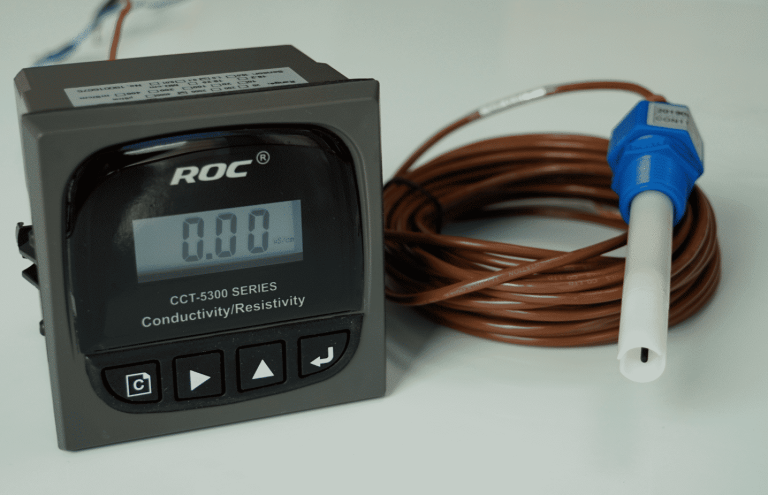
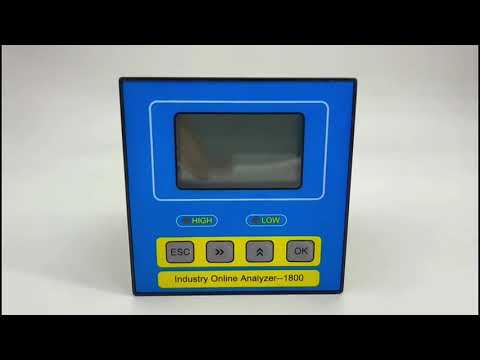
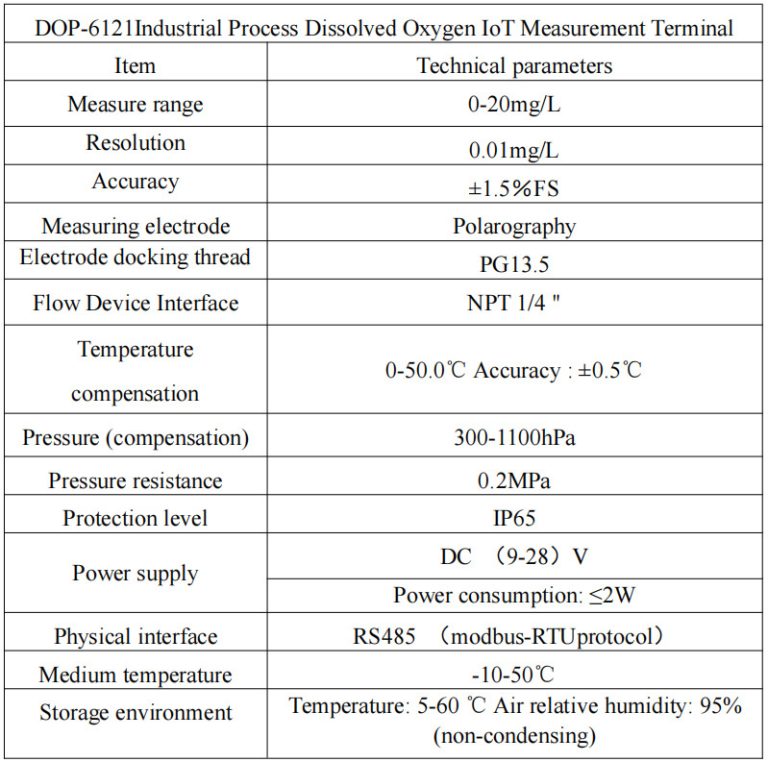
Shanghai ChiMay’s multi-parameter transmitters simultaneously process data from conductivity sensors, pH electrodes, dissolved oxygen transmitters, and corrosion probes, calculating both instantaneous corrosion rates and long-term trend data.
Data Logging and Alert Configuration
Modern monitoring systems should provide:
- Real-time corrosion rate display with trend visualization
- Configurable alarm thresholds for immediate operator notification
- Historical data storage for trend analysis and maintenance planning
- Integration with CMMS for work order generation
- Remote access capabilities for centralized monitoring
Corrosion Rate Interpretation
Target Corrosion Rates
Recommended corrosion rates for cooling water systems vary by metallurgy:
| Metal | Acceptable Rate | Warning Level | Critical Level |
|---|---|---|---|
| Carbon Steel | < 0.05 mmpy (< 2 mpy) | 0.05-0.13 mmpy | > 0.13 mmpy |
| Stainless Steel | < 0.005 mmpy (< 0.2 mpy) | 0.005-0.02 mmpy | > 0.02 mmpy |
| Copper Alloys | < 0.02 mmpy (< 0.8 mpy) | 0.02-0.05 mmpy | > 0.05 mmpy |
| Admiralty Brass | < 0.02 mmpy (< 0.8 mpy) | 0.02-0.05 mmpy | > 0.05 mmpy |
Response Protocols
When monitoring indicates elevated corrosion rates, implement escalating responses:
Level 1 (Warning – 1.5x normal rate):
– Increase monitoring frequency
– Review recent water treatment adjustments
– Check for process upsets or contamination events
Level 2 (Elevated – 2x normal rate):
– Initiate additional water testing
– Adjust corrosion inhibitor dosage
– Inspect corrosion coupons for morphology changes
Level 3 (Critical – 3x normal rate or absolute threshold exceeded):
– Immediate system inspection
– Emergency treatment intervention
– Consider controlled shutdown for inspection
Case Study (Illustrative Composite)
The following composite example reflects outcomes commonly reported when cooling systems move from periodic testing to continuous electrochemical monitoring:
Initial Conditions:
– Carbon steel corrosion rates well above target (several times the 2 mpy guideline)
– Recurring heat exchanger failures each year
– Corrosion-related maintenance and replacement costs dominating the water program budget
Implementation:
– Installation of LPR corrosion probes at tower basins and critical heat exchangers
– Integration with existing conductivity and pH monitoring
– Automated corrosion inhibitor feed linked to corrosion rate signals
Results Within About 18 Months:
– Corrosion rates brought down to near-target levels
– Heat exchanger failures effectively eliminated
– Corrosion-related maintenance costs cut by roughly two-thirds or more
Conclusion
Electrochemical corrosion monitoring provides cooling water system operators with actionable intelligence for preventing corrosion-related failures. The combination of LPR and ER probe technologies enables both rapid response to changing conditions and long-term trend analysis for maintenance planning.
Shanghai ChiMay’s integrated cooling water monitoring solutions combine electrochemical measurement capabilities with full water quality parameter coverage, enabling comprehensive corrosion management programs that protect critical equipment while optimizing treatment costs.