Conductivity is the cheapest and fastest measurement available on a reverse osmosis (RO) train, and it touches nearly every decision an operator makes: whether to adjust pretreatment, whether to clean, whether to push recovery, and whether the permeate is actually fit to send out.
Table of Contents
Where RO Stands
Desalination is now a mainstream supply source. The International Desalination Association puts global contracted desalination capacity above 100 million m³ per day, with membrane processes making up the large majority of installed and new capacity — RO is the default choice for new seawater plants because its energy demand is a fraction of thermal distillation’s. On the demand side, WHO and UNICEF estimate that around 2.2 billion people lack access to safely managed drinking water, which is the pressure driving that build-out.
Conductivity Measurement on an RO Train
Conductivity is measured by applying an alternating voltage between electrodes and reading the resulting current. In practice the alternating frequency has to be high enough to suppress polarisation and double-layer effects at the electrode surface, which is one reason four-electrode cells are common in process water: two electrodes drive current, two sense voltage, and the measurement becomes much less sensitive to electrode surface condition and cable resistance than a two-electrode cell.
Temperature compensation is not optional. Conductivity changes roughly 2% per °C for typical waters, so a 10 °C shift will move the reading far more than most process changes of interest. Standard practice is to reference readings to 25 °C; ASTM D1125 is the relevant standard for electrical conductivity and resistivity of water and includes the temperature-correction basis. Solutions with unusual ionic composition — concentrated brines, for example — do not follow the standard compensation curve exactly, which is why high-recovery RO concentrate is a harder measurement than seawater feed.
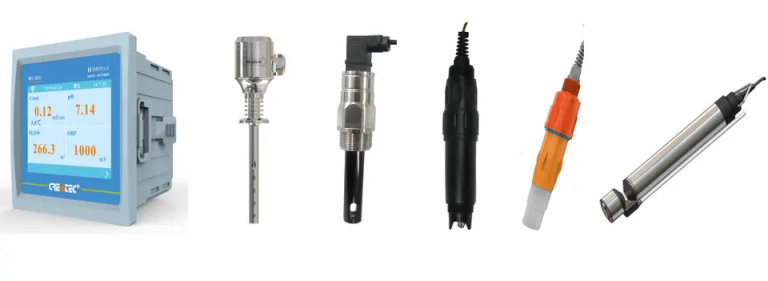
Shanghai ChiMay’s conductivity sensors include automatic temperature compensation, and the seawater-calibrated versions target accuracy of ±0.5% across the measurement range.
Where the Measurement Earns Its Place
Feedwater quality
Feed conductivity establishes the baseline for the whole train. Combined with temperature and SDI it drives pretreatment dosing, and a step change in feed conductivity is usually the first sign that intake conditions or a seawater source have changed.
Membrane performance and cleaning decisions
Permeate and concentrate conductivity together give salt passage, which is the cleanest early indicator of membrane degradation and of leaks past an O-ring or interconnector. Trending normalised salt passage against temperature-corrected permeate flow is what turns a cleaning decision from calendar-based to condition-based: clean when the normalised data says performance has moved, not because a quarter has passed. That generally reduces cleaning frequency and avoids both premature cleaning (which shortens membrane life) and late cleaning (which costs energy).
Product water verification
Permeate conductivity is the routine check that the product meets its specification, whether the destination is potable supply, industrial process water or irrigation. The setpoint should be set with enough margin that a slow upward drift triggers investigation before a specification limit is reached, and the alarm should be tied to diversion or recycle logic rather than just an operator notification.
The WHO Guidelines for Drinking-water Quality do not set a health-based guideline for total dissolved solids; TDS is addressed as an acceptability (palatability) parameter, with concentrations below roughly 600 mg/L generally considered acceptable to consumers. Where conductivity is used for compliance, it is usually against a national or utility specification rather than a WHO health value — worth checking before a setpoint is written into a permit response plan.
Sensor Selection for Desalination Service
The marine environment
Seawater duty means continuous chloride exposure, biofouling and vibration. IP68 rated housings are the sensible minimum for anything that can be submerged or washed down. Fouling behaviour matters more than any headline material claim: copper-bearing alloys are used in some marine applications because copper ions suppress biological growth, but material choice is application-specific and has to be balanced against corrosion resistance and the metals the plant is allowed to discharge. Titanium or Hastelloy electrodes and bodies are the common answer for seawater and concentrate service.
Inline versus flow-through
Inline installation in the process pipe gives a direct, fast measurement with no sample conditioning, at the cost of accessibility for maintenance. Flow-through (extractive) installations add a sample line and pump, but let the sensor be isolated and cleaned without interrupting the process, and make it practical to condition the sample temperature before measurement. On large trains, many plants use inline sensors at the critical control points and flow-through cells where maintenance access is the deciding factor.
Integration with Plant Control
Conductivity sits at the centre of three control loops on a modern RO plant:
- Recovery control — using feed, permeate and concentrate conductivity to balance production against scaling risk and specific energy consumption. Pushing recovery raises production but concentrates the brine and increases pressure demand, and the trade-off is different for every feed water.
- Cleaning scheduling — normalised performance data triggering clean-in-place rather than a fixed interval.
- Pretreatment dosing — antiscalant and acid dosing adjusted to the actual ionic load rather than a fixed dose.
Because all of these depend on data continuity, sensor availability is a design consideration. Duplicated sensors on the critical loops (feed and permeate) and a documented verification routine are more valuable than a single higher-specification instrument.
Practical Maintenance
- Verify against a certified standard at a frequency matched to the consequence of error, not to habit
- Keep a written record of verification results so drift trends are visible
- Clean at the first sign of drift rather than on a schedule; a conductivity cell that reads low because of coating will quietly let a membrane problem develop
- Check cable and connector integrity after any maintenance on adjacent equipment — most “sensor faults” on RO plants are connection problems
- Confirm the temperature element is reading correctly, since compensation errors look exactly like process changes
Wrapping up
Conductivity measurement on an RO plant is not glamorous, but it is the measurement that ties feed quality, membrane condition, product quality and energy use together. Four-electrode cells with proper temperature compensation, installed where the operator can maintain them and verified against traceable standards, will do more for plant performance than any amount of additional instrumentation on the non-critical side of the train. Shanghai ChiMay’s desalination instruments are built for that duty — seawater-rated cells, automatic temperature compensation, and the standard industrial outputs needed to put the data into a SCADA system.