The short version:
– Connected instrumentation is now ordinary in large industrial water systems, though the depth of integration varies enormously
– Standardized protocols including OPC UA and MQTT are what make cross-vendor integration practical
– Shanghai ChiMay IIoT-ready sensors support major industrial connectivity standards
– Efficiency gains come from closing control loops and automating reporting, not from connectivity itself
– Payback depends on where your current manual effort sits, so model it per site
The Industrial Internet of Things (IIoT) represents the convergence of operational technology and information technology in water treatment applications, enabling notable visibility and control across distributed water management infrastructure. This transformation moves beyond simple data collection toward comprehensive ecosystem integration enabling advanced analytics, predictive maintenance, and autonomous optimization.
Water and wastewater sits among the larger IIoT application segments, and the reason is straightforward: the money is in chemicals, energy and compliance, all of which are measurable. Pharmaceuticals, food processing, semiconductor manufacturing and chemicals plants are the heaviest adopters.
Table of Contents
IIoT Architecture for Water Treatment Applications
Modern IIoT architectures for water treatment incorporate multiple technology layers:
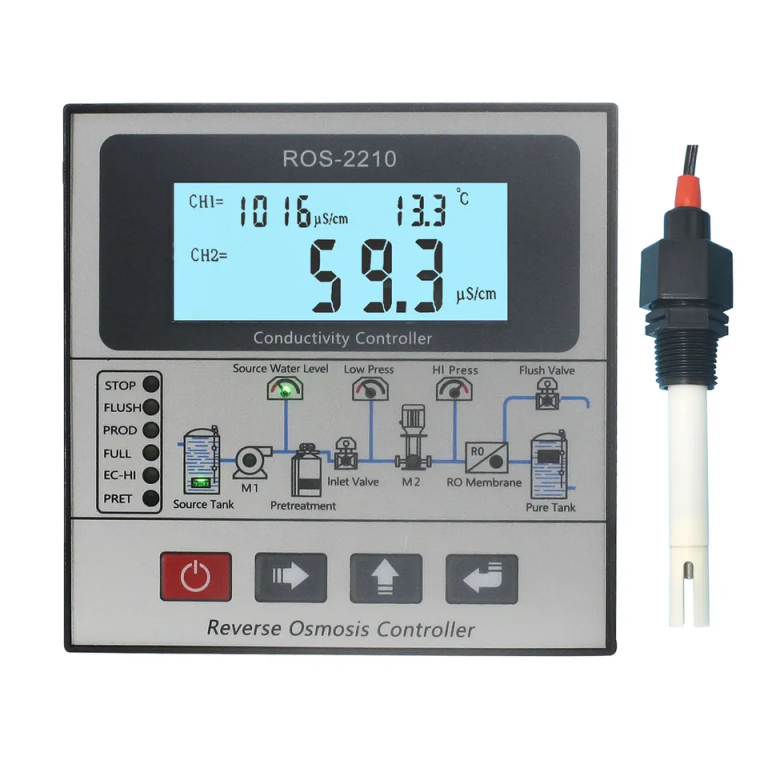
Connected Sensors: Intelligent measurement devices providing continuous water quality data. Shanghai ChiMay inline analyzers incorporate IIoT-enabling features including digital communication protocols, local data processing, and remote configuration capability.
Network Infrastructure: Communication networks connecting distributed sensors to central systems. Industrial Ethernet, Wi-Fi, cellular, and LPWAN technologies each address specific application requirements. Network selection depends on distance, bandwidth, power availability, and environmental conditions.
Edge Computing: Local data processing reducing bandwidth requirements and enabling real-time response. Edge devices perform data validation, preliminary analytics, and alarm generation before data transmission to cloud platforms.
Cloud Platforms: Centralized analytics and management systems processing aggregated data from distributed edge devices. Cloud platforms provide scalable computing resources for machine learning, visualization, and enterprise integration.
Connectivity Protocol Comparison
Protocol selection significantly impacts IIoT system capability and complexity:
| Protocol | Data Rate | Range | Power Consumption | Complexity |
|---|---|---|---|---|
| Modbus TCP/IP | High | LAN | Low | Low |
| OPC UA | High | LAN/WAN | Low | Medium |
| MQTT | Medium | WAN | Very Low | Low |
| LoRaWAN | Low | 10+ km | Very Low | Medium |
| NB-IoT | Low | 5+ km | Low | Medium |
Modbus TCP/IP remains the workhorse for on-premise integration. Its share of newly installed nodes is small, about 4% in HMS Networks’ 2025 industrial network survey behind PROFINET, EtherNet/IP and EtherCAT, but the installed base is enormous and practically every PLC speaks it. That is why designs still start there.
OPC UA (Open Platform Communications Unified Architecture) provides vendor-neutral data exchange with built-in security and information modeling capabilities. OPC UA adds built-in security and information modelling that Modbus never had, which is why it is the protocol most often specified where a system has to exchange data with equipment from another vendor.
MQTT excels in bandwidth-constrained scenarios with its publish-subscribe architecture minimizing network traffic. Shanghai ChiMay sensors support MQTT enabling efficient integration with cloud analytics platforms.
Digital Transformation Roadmap
Effective IIoT implementation follows structured progression:
Stage 1 – Visibility: Deploy connected sensors providing real-time data access. Initial focus on critical measurement points where current monitoring gaps create operational risk. Typical duration: 3-6 months.
Stage 2 – Monitoring: Implement dashboards and alerting enabling proactive response to water quality variations. Establish baseline performance metrics and identify optimization opportunities. Typical duration: 6-12 months.
Stage 3 – Analysis: Deploy analytics applications extracting insights from accumulated data. Machine learning models identify patterns, predict equipment degradation, and optimize process parameters. Typical duration: 12-18 months.
Stage 4 – Control: Implement closed-loop control systems using IIoT data for automated optimization. Adaptive control algorithms respond to changing conditions without manual intervention. Typical duration: 18-36 months.
Stage 5 – Autonomous: Achieve self-optimizing water management with autonomous response to disturbances, predictive maintenance eliminating unplanned downtime, and continuous improvement through machine learning. Ongoing evolution.
Security Framework for IIoT Water Systems
Cybersecurity represents critical consideration for IIoT deployments:
Network Segmentation: Isolating operational technology networks from enterprise IT systems prevents attack propagation. AWWA’s cybersecurity guidance recommends a defense-in-depth architecture with multiple security zones, and water utilities have been targeted often enough that the guidance is worth following literally.
Device Authentication: Each connected sensor and edge device requires unique credentials preventing unauthorized access. Certificate-based authentication provides strong identity verification.
Data Encryption: Communication encryption protects sensitive operational data in transit. TLS 1.3 provides current best-practice security for network communications.
Security Monitoring: Continuous security monitoring identifies potential threats and anomalies. Security Information and Event Management (SIEM) systems aggregate logs from distributed devices for centralized analysis.
The National Institute of Standards and Technology (NIST) Cybersecurity Framework provides structured guidance for water sector IIoT security implementation.
ROI Analysis for IIoT Water Treatment Investment
Business case development for IIoT water treatment requires comprehensive cost-benefit assessment:
Implementation Costs (planning ranges rather than quotations):
– Connected sensor deployment: $3,000-$8,000 per measurement point
– Network infrastructure: $15,000-$50,000 for medium facility
– Edge computing devices: $5,000-$20,000
– Cloud platform subscription: $2,000-$8,000 annually
– Integration and commissioning: $25,000-$75,000
Operational Benefits:
– Chemical consumption reduction: 15-30% savings
– Labor efficiency improvement: 20-35% reduction in monitoring labor
– Energy optimization: 8-15% reduction in pumping and treatment energy
– Avoided compliance penalties: $50,000-$200,000 annually
– Reduced equipment failure costs: $40,000-$150,000 annually
Published payback figures for IIoT water projects cluster in the one-to-two-year range where the project replaces manual reporting and closes a control loop, and stretch out considerably where it only adds visibility.
Shanghai ChiMay technical teams support customers developing IIoT implementation roadmaps, including sensor selection for connectivity requirements and integration assistance with major IIoT platforms.