Table of Contents
Introduction
Desalination keeps expanding as water scarcity intensifies across arid regions, and the market now measures in the tens of billions of dollars annually. Reverse osmosis (RO) dominates the field—industry capacity data put RO at roughly 70% of global installed desalination capacity. Membrane performance degradation remains a persistent challenge; fouling and scaling are among the most common causes of operational disruption in RO plants.
Conductivity monitoring is the workhorse measurement for catching these problems early. By continuously measuring dissolved solids concentrations, operators detect membrane integrity issues before they escalate into costly failures.
Understanding Conductivity Measurement in Desalination
Conductivity, measured in microsiemens per centimeter (μS/cm), correlates directly with total dissolved solids (TDS) concentration in aqueous solutions. In RO systems, it serves as a real-time indicator of salt rejection efficiency.
Shanghai ChiMay inline conductivity electrodes use four-electrode technology to deliver stable measurements across the 0.1 μS/cm to 200 mS/cm range required in desalination applications. The sensor’s platinum electrodes maintain calibration stability for 12+ months, which matters in remote desalination facilities where a maintenance visit is expensive.
Conductivity-based monitoring catches membrane breaches that pressure-based methods alone can miss. A leaking O-ring or cracked permeate spacer shows up almost immediately as a permeate conductivity rise, while differential pressure and normalized flow trends move slower and can lag a salt passage failure considerably.
Membrane Fouling Prevention Through Continuous Monitoring
Membrane fouling occurs when suspended solids, organic compounds, and scaling minerals accumulate on membrane surfaces, reducing permeate flux and raising energy consumption. Real-time conductivity monitoring supports proactive cleaning schedules: rising concentrate conductivity and shrinking feed-to-permeate conductivity differentials give operators the trend data they need to clean before fouling hardens into irreversible flux loss. Plants that clean on trend rather than on calendar typically recover flux with less aggressive chemistry.
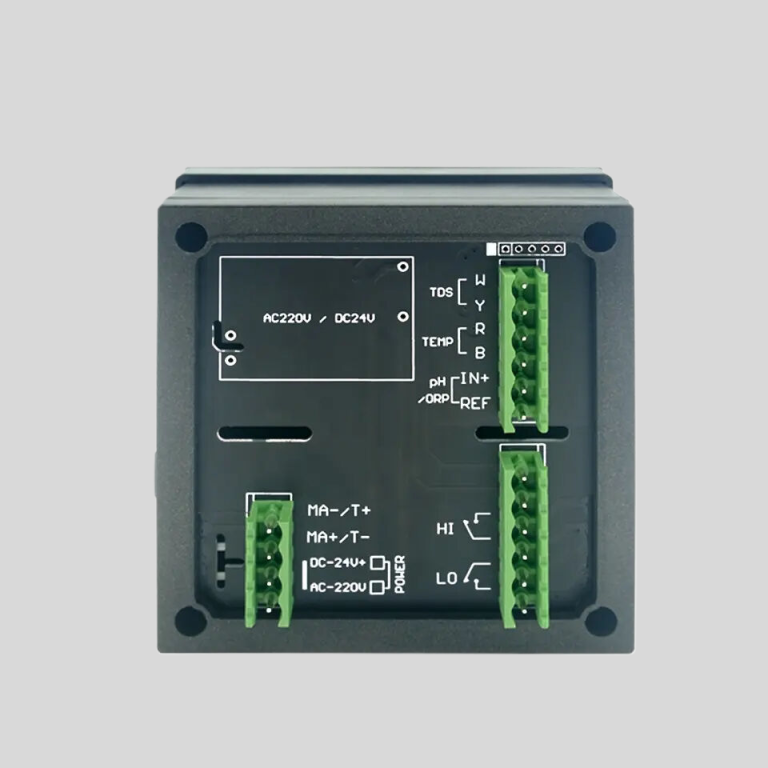
Shanghai ChiMay conductivity transmitters integrate with SCADA systems via Modbus RTU/TCP protocols, enabling automated cleaning cycle triggers when conductivity thresholds are exceeded. This cuts routine manual intervention while keeping product water quality consistent.
Salt Rejection Optimization
The relationship between conductivity and salt rejection gives operators actionable performance data. When permeate conductivity rises despite constant feed conditions, membrane degradation is likely underway.
Modern RO membranes deliver salt rejection above 99% when the system is healthy. Conductivity monitoring does not change what the membrane can do—what it changes is how fast you notice when rejection starts to slip. A slow O-ring leak that might otherwise surface weeks later in a laboratory sample shows up within minutes online, while the repair is still cheap.
Economic Benefits of Continuous Conductivity Monitoring
The capital investment in online conductivity monitoring typically ranges from $2,500-$8,000 per measurement point, depending on sensor specifications and integration requirements. For medium-scale desalination facilities, operational savings usually cover that expenditure within the first couple of years of operation.
Key economic advantages include:
- Reduced membrane replacement frequency: cleaning on actual condition rather than fixed schedules extends membrane life
- Energy consumption control: keeping the system clean holds specific energy consumption down
- Labor cost savings: less manual sampling and laboratory analysis
- Compliance assurance: consistent product quality; water delivered to the network typically has to meet drinking water TDS requirements—for example, the U.S. EPA secondary standard of 500 mg/L TDS
Integration Best Practices
Successful conductivity monitoring implementation requires strategic sensor placement throughout the RO train. Recommended locations include:
- Feed water inlet: baseline water quality assessment
- Concentrate outlet: scaling potential evaluation
- Permeate stream: product quality verification
- Cartridge filter inlet: pre-filtration efficiency monitoring
Shanghai ChiMay 2-in-1 mini transmitters combine conductivity and temperature measurement in a compact form factor suited to space-constrained installations, and they lower total installed cost by avoiding separate sensor penetrations, wiring runs, and commissioning work.
Conclusion
Real-time conductivity monitoring is an essential investment for desalination facilities optimizing membrane performance, controlling operating costs, and holding product quality steady. With measurement accuracies of ±0.5% and integration across standard industrial protocols, Shanghai ChiMay inline conductivity solutions provide the reliability and precision desalination operations demand.
Facilities running continuous conductivity monitoring catch membrane integrity problems while they are still cheap to fix—and that, more than any single percentage, is where the return on this investment comes from.