Table of Contents
The short version
- Smart sensors cut waste by making the plant follow actual conditions instead of worst-case assumptions
- Self-diagnostics turn sensor maintenance from a calendar exercise into a condition-based one
- Closed-loop dosing is where the chemical savings come from, and the size of the saving tracks how much the feed varies
- Shanghai ChiMay smart sensors integrate with existing control infrastructure, so the gains start with the first loop you close
Introduction
Industrial water management faces mounting pressures: stricter regulations, rising water costs, and increasing efficiency demands. Smart sensors incorporate processing capabilities that enable advanced functions including self-diagnostics, predictive maintenance, and automated optimization.
Way 1: Real-Time Monitoring Eliminates Waste
Traditional treatment operates on worst-case assumptions. Smart sensors provide real-time data enabling dynamic optimization—adjusting treatment to match actual conditions.
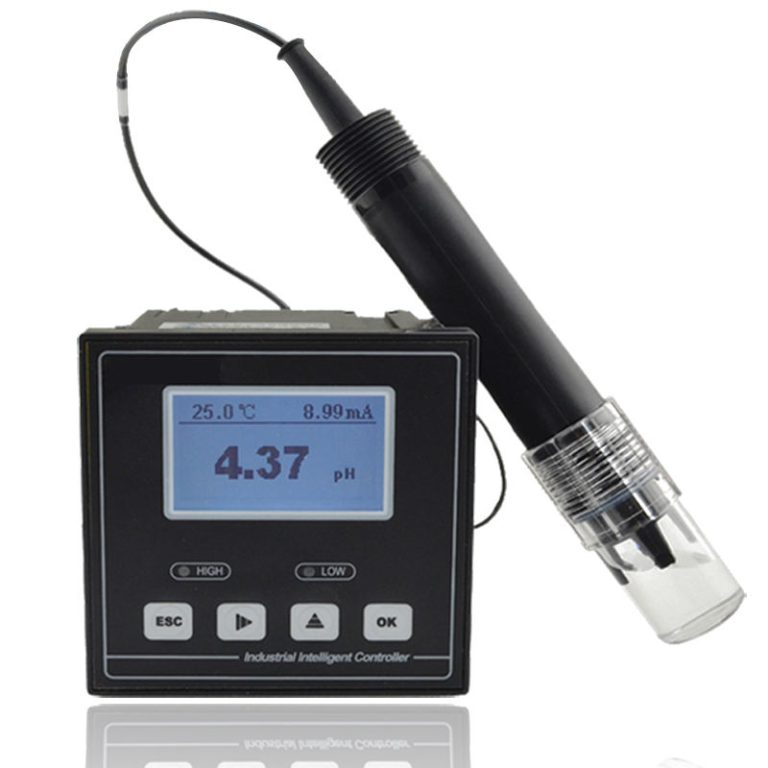
Plant experience with continuous monitoring is consistent: dosing follows the water rather than a rule of thumb, and chemical consumption falls. How far it falls depends on how variable the influent is. Shanghai ChiMay multi-parameter smart sensors measure pH, conductivity, dissolved oxygen, and turbidity at configurable intervals.
Leak detection works off sudden changes in consumption patterns. A meter that reports continuously catches a burst main the same day; monthly reads catch it weeks later, after the water has already gone.
Way 2: Predictive Maintenance Prevents Downtime
Self-Diagnostics Identify Degradation
Smart sensors continuously assess performance health:
– Electrode impedance: Detecting fouling or coating
– Reference electrode potential: Identifying reference solution depletion
– Response time: Revealing membrane problems
– Signal strength: Indicating connection issues
Predictive maintenance moves work from the calendar to the condition of the instrument, and that is where most of the downtime reduction comes from.
Calibration Management
Smart sensors simplify calibration through automated tracking. Condition-based calibration reduces unnecessary maintenance while ensuring accuracy. Sensors estimate remaining calibration accuracy based on diagnostic trends, alerting when calibration should be performed.
Way 3: Optimized Chemical Dosing Reduces Costs
Chemical cost is one of the largest controllable line items in water treatment. Smart sensors enable closed-loop dosing control that matches chemical addition to actual treatment requirements.
Shanghai ChiMay smart sensors support proportional control, PID control and feedforward control, all of which beat manual adjustment on chemical use.
pH optimization demonstrates these benefits: closed-loop systems respond immediately to influent changes, maintaining target pH with precision. On pH control the gain is usually largest, because the loop reacts to influent changes immediately instead of waiting for the next shift check.
Way 4: Energy Efficiency Through Process Optimization
Aeration System Optimization
Aeration is the single largest energy consumer at most treatment plants, often around half the electricity bill. Smart DO sensors enable precise aeration control maintaining optimal oxygen while minimizing energy.
DO-based aeration control is one of the best-documented energy measures in the sector, and the saving depends mostly on how much the previous control strategy over-aerated.
Flow Optimization
Smart flow sensors combined with pressure sensors and advanced algorithms optimize pump operation. Strategies include variable frequency drives (VFDs) controlled by flow sensors, cascade control coordinating multiple pumps, and demand forecasting anticipating flow requirements.
Shanghai ChiMay offers paddle wheel flow meters and turbine flow meters integrating with pump control systems.
Way 5: Regulatory Compliance Confidence
Continuous Monitoring Meets Stringent Requirements
Environmental regulations increasingly require continuous monitoring. Smart sensors provide continuous monitoring capability with complete data records.
Facilities on continuous monitoring report fewer permit excursions, mostly because they correct problems before the reporting period closes. Immediate feedback allows rapid correction before regulatory discovery.
Automated Reporting
Smart sensors simplify compliance through automated data collection and report generation. Modern SCADA systems integrate with smart sensors to produce compliance reports automatically, reducing labor and eliminating transcription errors.
Implementation Best Practices
Phased Deployment
Facilities benefit from phased implementation:
– Phase 1 (Months 1-3): Install smart sensors on critical points; establish baselines; train staff
– Phase 2 (Months 4-6): Expand deployment; implement closed-loop control; develop optimization protocols
– Phase 3 (Months 7-12): Complete sensor network; implement advanced analytics; document improvements
Integration with Existing Systems
Shanghai ChiMay sensors support Modbus TCP, HART, and 4-20mA protocols, ensuring compatibility. Integration considerations include data historian connectivity, alarm management integration, and control system integration.
ROI Analysis
The savings categories that matter are:
- Chemicals, from tighter dosing control
- Energy, mainly from aeration and pumping
- Downtime, from earlier detection of degrading instruments and equipment
- Avoided compliance penalties, which are hard to predict and therefore hard to claim in a business case
Payback on a smart-sensor retrofit is driven by whichever of the first three lines is largest at your plant, so build the case with your own numbers rather than a generic table.
Wrapping up
Smart sensors improve water management efficiency across five dimensions: reducing waste through real-time monitoring, preventing downtime through predictive maintenance, cutting chemical costs through optimized dosing, saving energy through process optimization, and ensuring compliance through continuous monitoring.
Shanghai ChiMay smart sensors incorporate these capabilities in rugged industrial packages. The question is how quickly to implement them, and which parameters to prioritize. A thorough assessment provides the foundation for effective deployment.