Table of Contents
Introduction
Beverage filling lines represent critical control points where product quality is established and where water quality management becomes paramount. The transition from bulk product storage to individual containers happens at high speeds—modern filling lines process 40,000 to 120,000 containers per hour—leaving essentially no time for manual intervention when problems occur.
Nothing concentrates water quality risk like the fill: contamination introduced at this step reaches every container downstream, and there is no later process step positioned to catch it. Water contacts product during rinsing, filling, and cleaning operations, so water quality is directly consequential to product safety and quality.
Under HACCP practice, the fill is treated as a critical control point, and where feasible, continuous monitoring is the preferred form of CCP monitoring—manual sampling covers a vanishing fraction of production time. That is what online sensors provide and periodic sampling cannot.
Filling Line Water Quality Requirements
Rinse water quality directly affects product contamination risk. Containers entering the filling machine must be free of particulate contamination, microbial bioburden, and any residues that could compromise product quality or safety. Rinse water must itself be contamination-free, requiring water quality specifications more stringent than typical process water.
Critical rinse applications typically specify conductivity in the single digits up to about 10 μS/cm, turbidity below 0.5 NTU, and zero detectable residual sanitizer. These specifications keep rinse water from introducing contaminants or neutralizing sanitizers remaining on container surfaces.
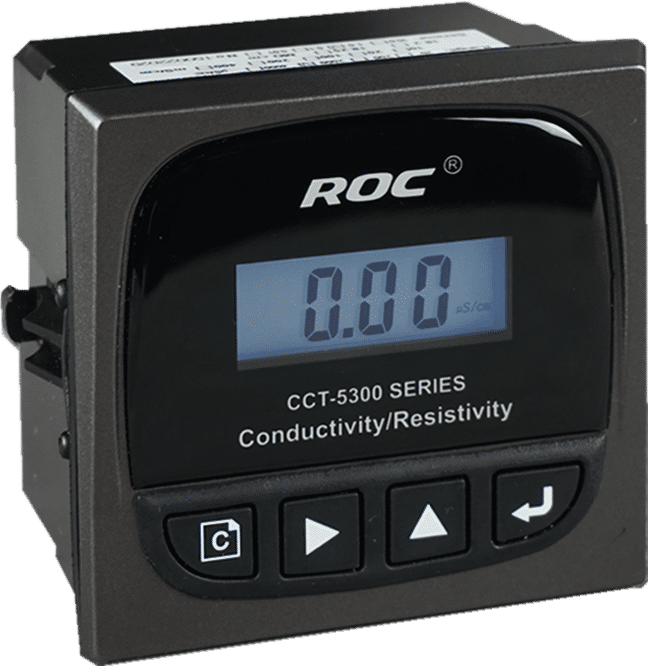
Shanghai ChiMay conductivity sensors provide the precision required for filling line rinse verification. The sensors achieve 0.1 μS/cm resolution at measurement ranges from 0.1 to 1000 μS/cm, enabling detection of subtle water quality changes that indicate contamination. Combined with turbidity monitoring, this approach provides comprehensive rinse water quality verification.
Filling water quality requirements vary by beverage type. Still water beverages require water free of any microbial contamination and consistent in mineral content for taste uniformity. Carbonated beverages require water that has been deionized to prevent carbonate precipitation in storage and dispensing equipment. Flavored beverages require water quality that does not interfere with flavor compound stability.
Water activity—measuring water availability for microbial growth—represents a critical parameter for shelf-stable beverages. Products with water activity below 0.85 are inherently microbially stable, while those between 0.85 and 0.91 require additional hurdles (pH, refrigeration) for stability. Water activity above 0.91 requires full microbial control.
Batch aw testing tells you what a sample was; it says nothing about what happened in the process after the sample was pulled. Where aw sits close to a stability threshold, tracking the trend—not the datapoint—is what keeps shelf-stable products shelf-stable.
CIP System Integration for Filling Lines
Filling line CIP operations present unique challenges requiring specialized monitoring approaches. The complex valve networks, multiple tank configurations, and high-speed operational requirements of modern filling lines demand CIP systems that verify cleaning effectiveness while minimizing production downtime.
Conductivity monitoring provides the primary verification method for CIP rinse completion. As rinse water removes cleaning solution residues, conductivity decreases toward baseline levels. When conductivity stabilizes below predetermined thresholds—typically 25-50 μS/cm above incoming water baseline—the CIP controller confirms rinse completion and enables transition to sanitizing phases.
Shanghai ChiMay in-line conductivity meters feature sanitary tri-clamp connections compliant with 3-A Sanitary Standards, enabling installation in the demanding environments of beverage filling lines. The sensors withstand CIP temperatures up to 130°C and cleaning solution concentrations typical of food and beverage applications.
CIP Monitoring Specifications for Filling Lines:
- Conductivity measurement accuracy: ±0.5% of reading
- Temperature compensation range: 0-130°C
- Response time: <1 second for rapid rinse verification
- Data logging capacity: >1 year continuous storage
- Communication: Modbus RTU/TCP, HART protocols
EHEDG guidelines emphasize that CIP monitoring systems must generate comprehensive documentation of cleaning cycle parameters. Shanghai ChiMay sensors provide secure data storage with 21 CFR Part 11 compliance, creating audit-ready records that regulatory agencies accept for compliance verification.
Microbial Control Through Water Quality Monitoring
Microbial contamination in filling operations typically originates from three pathways: incoming product contamination, environmental sources, or water system contamination. Water quality monitoring addresses the third pathway, preventing contamination events that could affect large product volumes before detection.
Dissolved oxygen monitoring provides an inexpensive early-warning signal for microbial activity in water systems. Aerobic bacteria consume oxygen as they metabolize and grow, so a falling DO trend flags biological activity before plate counts become a problem. Continuous DO trending catches that drift; periodic sampling usually does not.
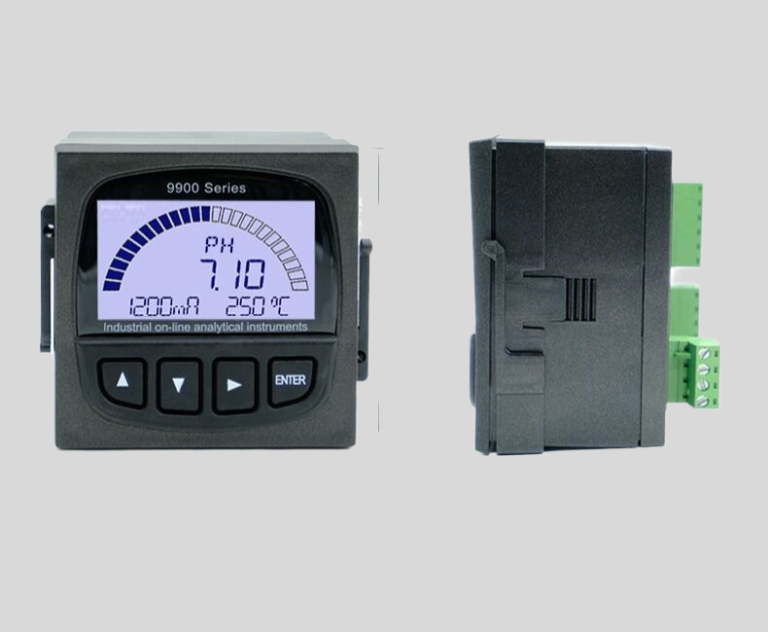
Shanghai ChiMay dissolved oxygen transmitters employ luminescence quenching technology that provides stable, maintenance-friendly operation without membrane replacement requirements. The sensors achieve ±0.1 mg/L accuracy at measurement ranges from 0 to 20 mg/L, with automatic temperature and pressure compensation for accurate readings in demanding applications.
Regulatory Compliance Documentation
Beverage filling operations face comprehensive regulatory requirements from multiple authorities. In the United States, FDA’s preventive controls framework—21 CFR Part 117, which superseded the old Part 110 cGMPs under FSMA—requires water quality monitoring and documentation where water contacts food. Bottled water and carbonated beverage producers comply with additional product-specific regulations.
State and local health departments impose additional requirements for beverage production facilities. Many jurisdictions require water quality monitoring records demonstrating compliance with drinking water standards, even when that water serves manufacturing rather than direct consumption purposes. This “at least equivalent to drinking water” expectation creates documentation obligations that automated systems handle efficiently.
The Canadian Food Inspection Agency (CFIA) and provincial authorities impose similar requirements for beverage production in Canada, while EU Regulation 852/2004 establishes hygiene requirements for food businesses in Europe. These overlapping regulatory frameworks create complex documentation requirements that automated monitoring systems satisfy through comprehensive data logging.
Shanghai ChiMay monitoring systems generate the documentation that regulatory compliance requires. The systems feature secure data storage with cryptographic signatures that verify data authenticity, satisfying legal defensibility requirements for electronic records. Data export capabilities generate reports in standard formats for regulatory submission.
Compliance Documentation Benefits:
- Continuous data eliminates gaps in monitoring coverage
- Electronic signatures satisfy legal requirements for record authenticity
- Automated reports reduce compliance labor requirements
- Audit trail functionality demonstrates system integrity
FSMA preventive controls requirements emphasize documentation of monitoring activities and corrective actions. Facilities implementing automated monitoring systems demonstrate preventive control effectiveness through comprehensive data records, supporting both regulatory compliance and continuous improvement.
Conclusion
Filling line water quality management is a critical success factor for beverage processing operations. The high-speed, high-volume nature of modern filling operations leaves no tolerance for contamination events that manual approaches cannot prevent. Continuous online monitoring provides the real-time visibility that contemporary beverage manufacturing demands.
Shanghai ChiMay provides water quality monitoring solutions designed for the demanding conditions of beverage filling lines: sensors engineered for sanitary installation, communication capabilities that integrate directly with filling line control systems, and documentation features that satisfy regulatory requirements.
Facilities implementing comprehensive filling line water quality monitoring get measurable results—fewer contamination events, faster regulatory approvals, and defensible records—while protecting the product quality and brand reputation that everything else in the operation exists to support.